
Role of Synthetic Traffic in Performance Testing
Synthetic traffic is software-generated requests: load tests, monitors, canaries. See the uses and the risks to analytics, WAF rules and third parties.
Cloud testing guides cover running load and performance tests from cloud infrastructure instead of your own machines. You'll find how to load test Azure web apps, APIs and exchanges, where load tests fit into CI/CD and GitHub Actions, what a staging environment and a QA team are for, roundups of online load testing tools, and how LoadFocus features such as dashboards work.
Synthetic traffic is software-generated requests: load tests, monitors, canaries. See the uses and the risks to analytics, WAF rules and third parties.
HTTP/3 load testing: stock k6, JMeter, Gatling and Locust do not document HTTP/3 support. Learn what your test measures, how to check, and what to do.
How to load test a multi-region deployment: generate load from each user region, measure replication lag and failover, and check DNS routing and capacity.

Learn how to set performance budgets for web apps to optimize user experience and improve loading times in 2026. Boost your site's efficiency today.

Cache invalidation decides whether a load test measures your cache or your origin. How cold, warm and purged caches change results and how to test a purge.

Network jitter is variation in packet delay. Measure it with ping and iperf, learn what a load test can and cannot show about it, and how to read the spread.
Edge locations serve your users; load generators run in cloud regions. How to pick generator locations, split users per region and know the limits.

Validate infrastructure auto-scaling with load testing: ramp shapes that expose scaling lag, time-to-scale, the error window and scale-in under load.
Load tests can check that security controls hold under load: rate limits, login throttling and resource caps, backed by OWASP and NIST sources.

Cloud testing pricing models explained: pay-as-you-go, subscription and committed use, with break-even arithmetic and vendor prices read on 23 October 2026.

Automated test script generation with AI gives you a draft, not a verified test. A review checklist for load test scripts, with a flawed example fixed.

Continuous validation keeps checking performance after the merge, with scheduled load tests and production monitoring. Why a CI gate alone is not enough.
Performance testing serverless architectures: measure cold starts with percentiles, ramp past concurrency limits, protect your database, and cost the test.

Set up end-to-end multi-cloud performance testing, with distributed load generation, vendor-agnostic tooling and cost controls that hold.

Quantum computers do not change load testing today. Post-quantum TLS does: what NIST and the IETF standardised, and what to measure on your endpoints.

5G changes the client-side latency your users see, but a cloud load generator in a datacentre does not test the radio network. What 5G means for load testing.
What performance testing can and cannot say about accessibility: WCAG 2.2 timing rules, Lighthouse and axe-core checks, and how to run them beside load tests.
Serverless scaling is not a free pass. Why cold starts, concurrency limits and per-invocation cost make performance testing non-negotiable.
Relate load test results to business KPIs honestly: conversion by response-time bucket, SLOs and error budgets, and cost per request, with worked examples.
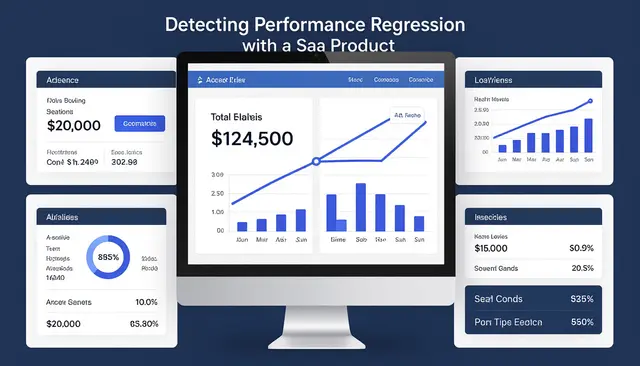
How to detect a performance regression automatically: pinned baselines, thresholds, run-to-run noise, a rank test across runs and git bisect to find the commit.
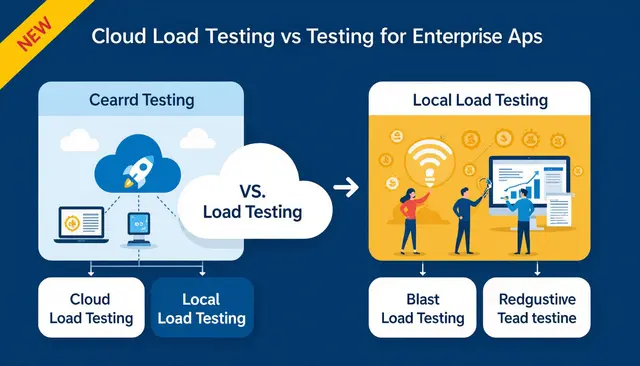
Cloud or local load testing for enterprises: how data residency, internal network access, governance and procurement should decide, not scale or cost alone.

Serverless computing changes load testing in three ways: what triggers the code, what you measure and what you pay. A short orientation with deeper guides.

How to performance test an AI chatbot: time to first token, tokens per second, concurrency, 429 rate limits, streaming and cost per conversation.
Which testing standards bear on cloud performance testing: ISO/IEC/IEEE 29119, ISO/IEC 25010 performance efficiency and ISTQB, and what each defines.
Wire load tests into CI/CD: which stage runs what, how to fail a build on thresholds, and how to keep results on GitHub Actions, GitLab, Jenkins and Azure.

Explore how cloud testing supports sustainable software development by optimizing resource usage, reducing waste, and driving green IT initiatives.
Why performance testing matters more for cloud-native apps in 2026, as rising complexity and user expectations reshape how teams test.
Which security and compliance standards touch cloud load testing: ISO 27001, NIST 800-53, SOC 2 and CSA CCM, and what each means for test data.
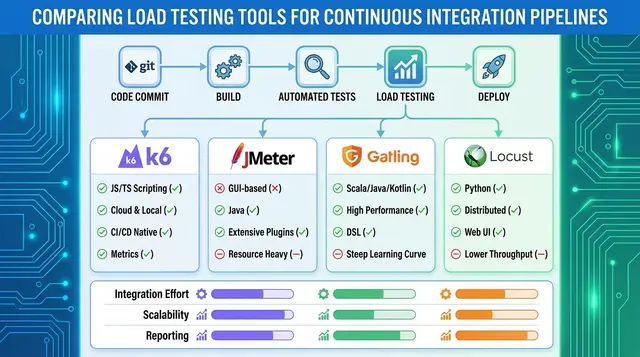
Compare JMeter, k6, Gatling, Locust, Artillery and LoadFocus for CI/CD: how each runs headless, fails a build on a threshold and scales beyond one runner.
Microservices load testing explained: service-level versus end-to-end tests, dependencies and mocks, tracing, autoscaling and circuit breaker behaviour.
Edge computing changes what a load test measures: mostly the CDN cache, not your origin. Edge function limits, how to test them, and the CDN load testing rules.
Continuous performance testing runs load tests on every change. What to run per pull request, nightly and before release, and how to fail a build on thresholds.

A practical plan for SaaS load testing: set targets from projected growth, model tenants, test regions, gate releases in CI and read the results.
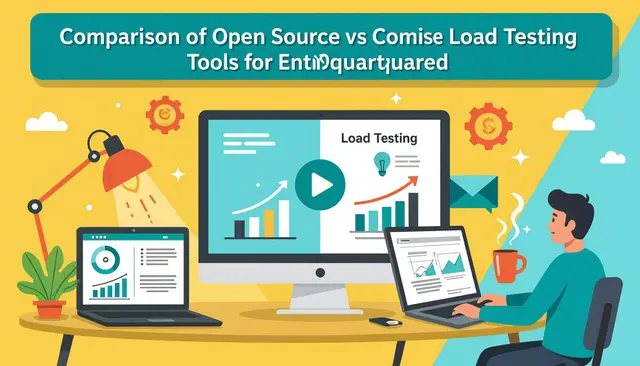
Open source vs commercial load testing tools compared on cost, scaling, CI/CD, support and team skills, with vendor prices read off their pages in October 2026.

Data-driven load testing gives each virtual user different data and paths. How to pick data, keep rows unique per user, model journeys and avoid mistakes.

What AI actually does in performance testing today: script drafting, result summaries and where it stops, with tools checked against their own docs.
Judge a platform on CI integration and result analysis, not on maximum virtual users.

Mix journeys by real proportion rather than testing each endpoint evenly. Vary data per user, or caching makes the system look faster than it is.
The main cloud testing challenges: environments unlike production, risky test data, noisy shared hardware, third-party services and cost, with a fix for each.
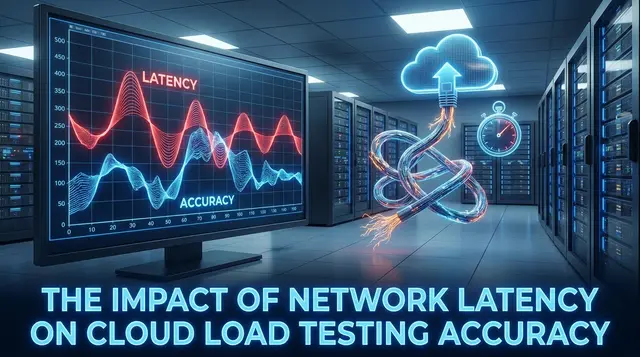
Every response time a load test records includes network latency. See how test location and new connections inflate results, and how to isolate server time.
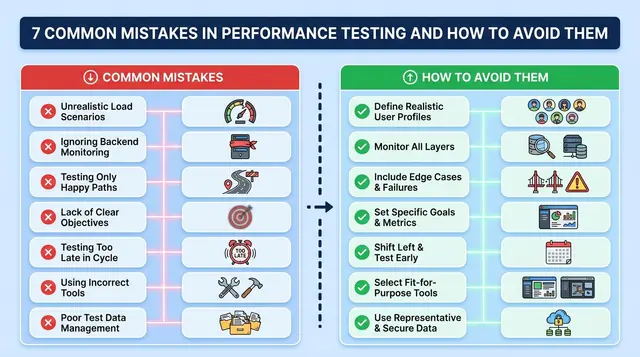
Seven performance testing mistakes that make results lie: testing late, staging unlike production, fake data, averages and an overloaded load generator.

Mobile is most of web traffic, and phones run on slower networks and CPUs. What to measure (Core Web Vitals, API load), on which conditions, and how to test.
Serverless changes how you read load test results: cold starts, throttling and downstream limits look different on the client and in the provider metrics.
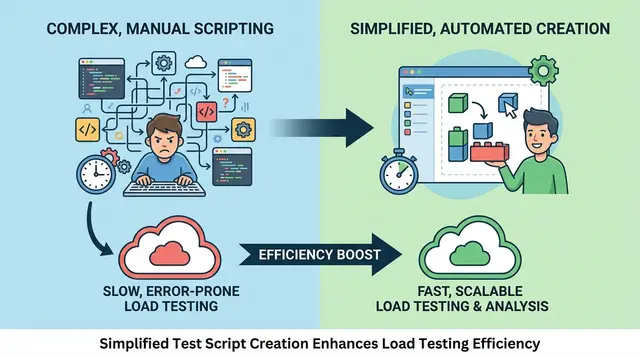
Simplified test script creation: five ways to get a load test script (write, record, import, AI draft, in-browser) and the checks any generated script needs.
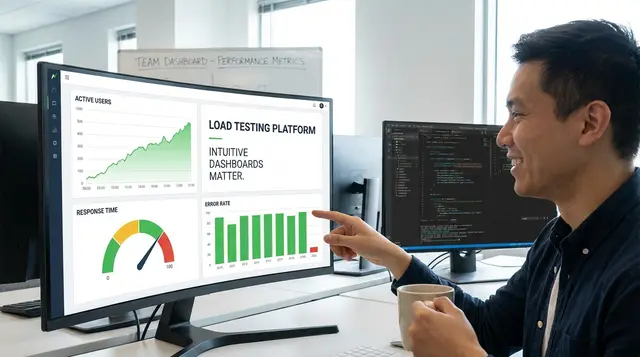
What an intuitive load testing dashboard shows: percentiles instead of averages, error rate, throughput, results per region and a trend against a baseline.
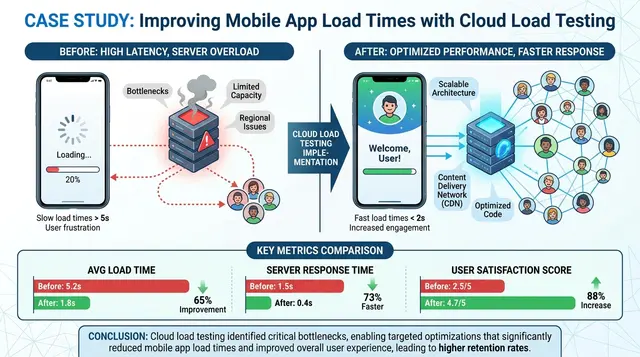
Measure mobile app load times with cloud load testing: record the launch requests, replay them under load from your users' regions, and read p95 and errors.
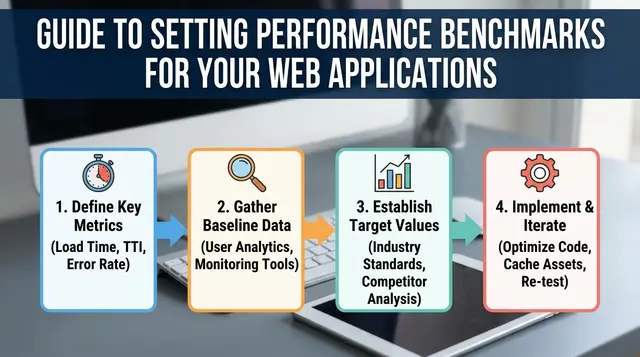
Performance benchmarks for web applications: Google's targets (LCP 2.5 s, INP 200 ms, CLS 0.1 at p75), p95 response time goals under load, and how to set them.
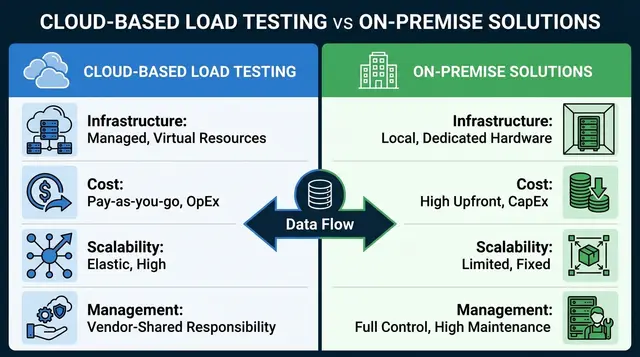
A startup guide to cloud vs on-premise load testing: what each costs in engineer time, where compliance really bites, and a rule for when to switch.
Cloud testing trends in 2026 for CTOs: six decisions on pipeline placement, test ownership, load generation, vendor risk, test data and AI use.

What makes a testing platform usable for a DevOps team: five checks to run in a trial, where easy tools fall short, and what LoadFocus offers.

LoadFocus runs your JMeter scripts in the cloud. Compare self-run Apache JMeter and LoadFocus on scaling, protocols, reporting and CI/CD for enterprise teams.
Seven cloud performance testing tools compared for 2026: what scripts each runs, where the load comes from, and how each fits CI, checked on vendor sites.

Automated load testing for microservices with LoadFocus: one test per service, pass/fail thresholds, a CI/CD gate and scheduled runs, step by step.
Sample non functional requirements with measurable targets for performance, availability and security, plus a template, e-commerce examples and tests.
A canary sends a small traffic slice to the new version so failures stay small and reversible.

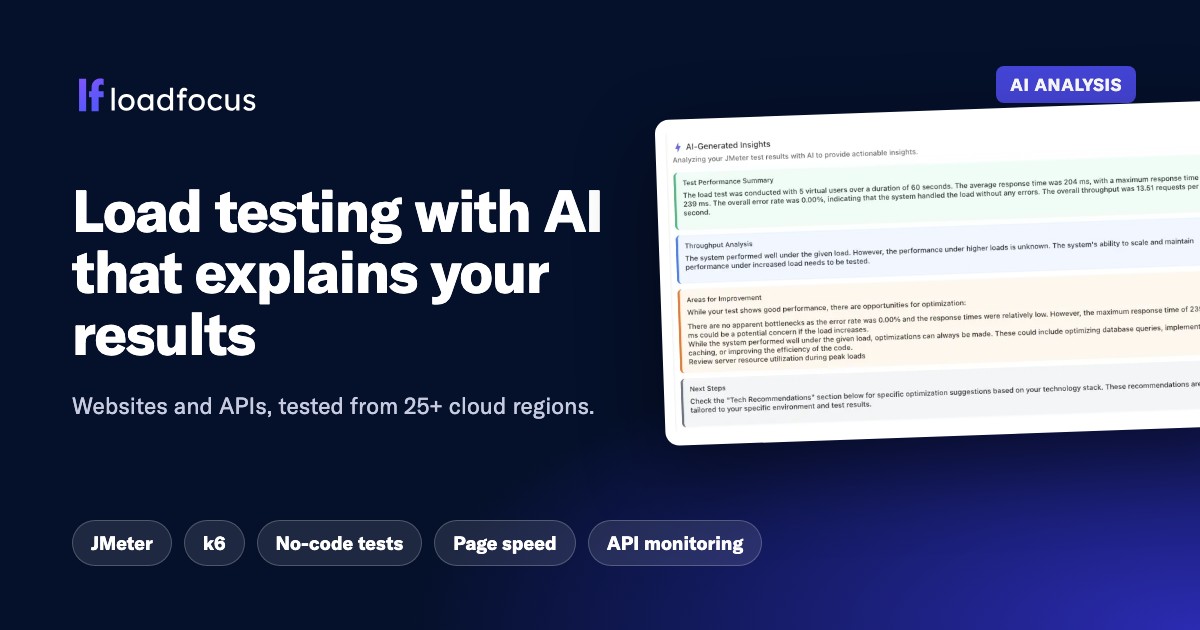
Run a load test without writing a script, then get AI analysis tuned to your tech stack. What it reads, what the output looks like, and what it cannot tell you.
Run a saved LoadFocus JMeter test from CircleCI and fail the build on a missed threshold. A checked config, traps in the docs, and how to test the gate.

A workflow is triggered by an event and runs jobs made of steps, which is the whole model.

Playwright drives Chromium, Firefox and WebKit through one API. Auto-waiting removes most of the sleep-based flakiness older frameworks suffer from.

QA is broader than finding bugs: it covers process, risk and release confidence.

Load test an Azure Web App without crashing it. Autoscaling reacts after load arrives, so test the scale-out itself, not the steady state.

Keep the pipeline fast. A suite people skip because it is slow provides no safety at all.
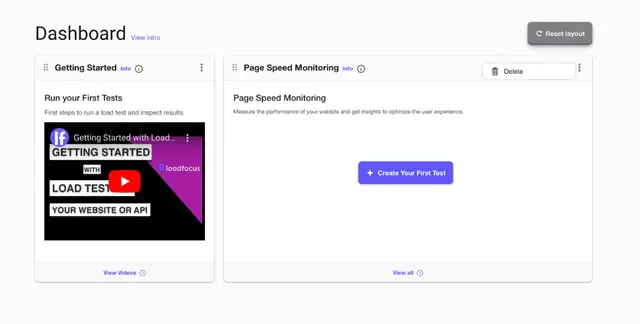
A dashboard is only useful if it shows the few numbers you act on. Arrange widgets around a question you ask often rather than around what is available.

Depth in one area beats shallow familiarity with every tool. Automation is a skill within testing, not a replacement for knowing what to test.

Releasing often only works if the pre-release checks are automated and identical every time.

The closer the parity, especially in data and scale, the more useful it is. A staging environment that drifts from production gives false confidence.

Exchanges fail at the order book and matching engine, not at the marketing pages.

Emulators catch layout and viewport problems quickly and cheaply. Test the viewports in your analytics rather than a generic device list.
Assert on content as well as status, since a wrong body is still a failure. Keep assertions cheap. Heavy ones distort the timings you are measuring.
Don’t miss out on the latest testing tips and tricks, tools and news related to software testing.
Already +20,000 members in the list.
Load test websites and APIs from 25 cloud regions, monitor page speed and uptime, and get AI analysis that explains your results in plain English.