Key takeaways
- Mobile users abandon faster and on worse networks, so the tolerance is lower than desktop.
- Test on throttled connections rather than office wifi.
- Measure time to interactive, since that is when the user can actually do something.
Is Your Infrastructure Ready for Global Traffic Spikes?
Unexpected load surges can disrupt your services. With LoadFocus’s cutting-edge Load Testing solutions, simulate real-world traffic from multiple global locations in a single test. Our advanced engine dynamically upscales and downscales virtual users in real time, delivering comprehensive reports that empower you to identify and resolve performance bottlenecks before they affect your users.
Why Performance Testing Is the Deciding Factor for Mobile-First Businesses
Speed Is the Price of Admission
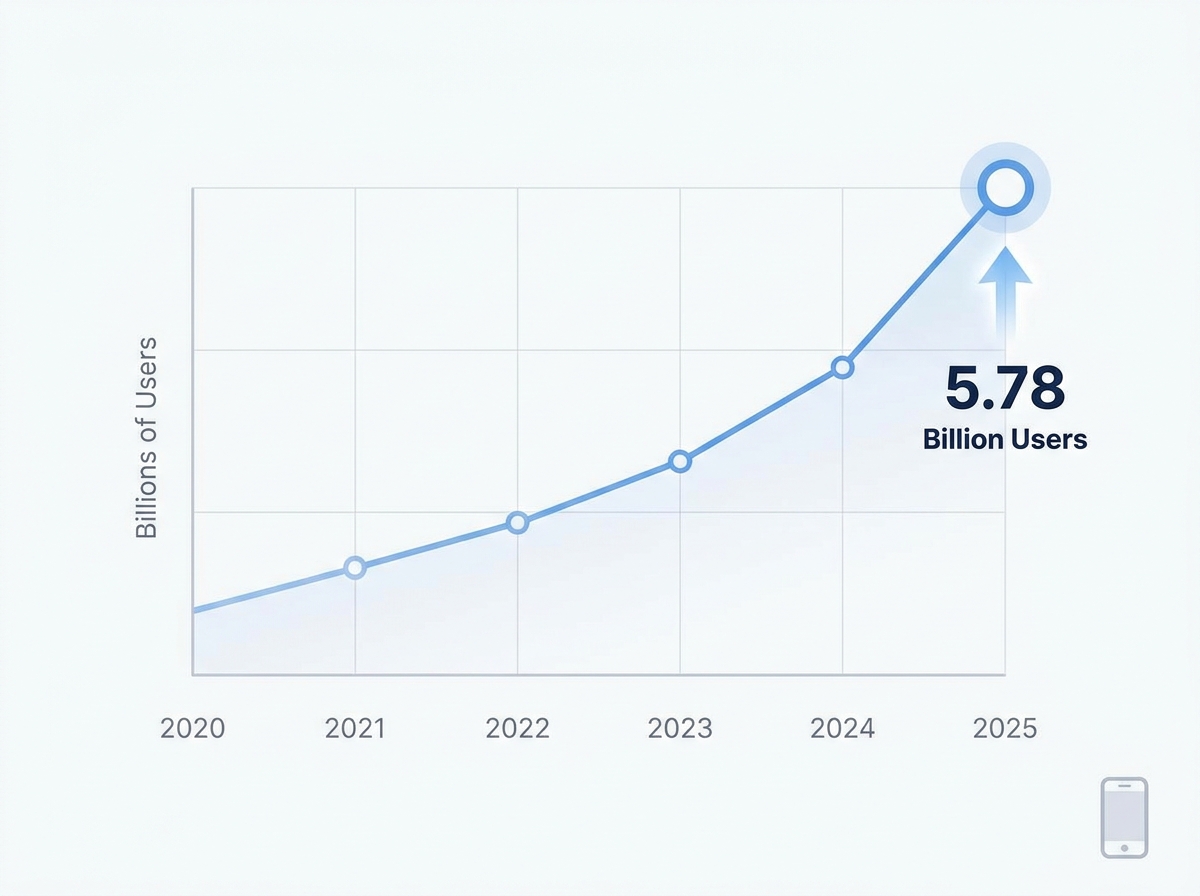
Mobile-first businesses often enter the market confident in their app’s speed, but the reality is that many overestimate their performance – and pay for it through user churn and lost revenue. With 5.78 billion unique mobile users worldwide as of October 2025, representing 70.1% of the global population, the pressure to deliver a fast, reliable experience is immense. In this environment, you’re competing not just for attention, but for the fleeting patience of users who expect instant results.
Mobile users demand apps that load quickly and respond smoothly, regardless of device or network. Yet, it’s common for teams to prioritize new features or visual polish, assuming that a “mobile-first” approach guarantees a quality experience. In practice, poor mobile performance quietly drives users away. Most won’t bother to complain – they’ll simply uninstall and move on.
Key Insight: Businesses that neglect mobile performance testing risk losing user loyalty and revenue, often without realizing the true scale of the impact.
Think your website can handle a traffic spike?
Fair enough, but why leave it to chance? Uncover your website’s true limits with LoadFocus’s cloud-based Load Testing for Web Apps, Websites, and APIs. Avoid the risk of costly downtimes and missed opportunities—find out before your users do!
Ignoring the Data Is Costly
The 5.78 billion mobile user figure is more than a statistic – it’s a wake-up call. With mobile accounting for the majority of digital engagement, even small delays can translate into significant losses in conversions and retention. Too often, teams rely on internal testing under ideal conditions – fast WiFi, flagship devices – while real users contend with mid-tier phones and inconsistent networks. This disconnect leads to missed bottlenecks and abandoned sessions.
Without systematic performance testing, businesses risk higher churn and missed growth opportunities. Relying on anecdotal feedback or limited device coverage is not enough to ensure a strong mobile experience.
Mobile-First Design Doesn’t Guarantee Real-World Performance
Adopting a mobile-first design philosophy is a step in the right direction, but it’s not a substitute for rigorous testing. Streamlined layouts and prioritized content help, but if your app falters under real-world conditions, those design gains are lost. Performance testing mobile-first businesses means evaluating your app across a spectrum of network speeds, device types, and usage scenarios – not just in controlled environments.
- Are you simulating slow or unstable network conditions?
- Have you tested responsiveness on budget and older devices?
- Do you monitor how your app handles traffic surges?
Many teams overlook these questions, assuming a handful of successful internal tests are sufficient. In reality, users expect every app on their device to deliver a consistently fast experience.
LoadFocus is an all-in-one Cloud Testing Platform for Websites and APIs for Load Testing, Apache JMeter Load Testing, Page Speed Monitoring and API Monitoring!
The Price of Overlooking Performance
When performance testing is delayed or deprioritized, issues multiply. Each second of lag erodes user trust, and every crash or timeout pushes users toward competitors. For mobile-first businesses, treating speed as optional is a costly mistake in a market where billions expect instant results.
Sustained performance testing is essential for keeping pace. Businesses that treat it as a core discipline, rather than an afterthought, are best positioned to retain users and grow.
Performance Testing: The Foundation of Mobile User Experience
Performance Is a Customer Experience Imperative
With 5.78 billion people using mobile devices, every millisecond of delay becomes a customer experience issue. For mobile-first businesses, performance testing is not just a technical task – it’s a strategic investment that determines whether users stay, spend, and recommend your product. Users often abandon slow or unreliable apps after a single poor experience, rarely giving second chances.
User Retention Depends on Speed and Reliability
There is a clear link between perceived speed, app reliability, and user retention. Mobile-first design requires teams to focus on essential features and responsive layouts. This discipline pays off: users notice and reward apps that work smoothly, regardless of network or device.
Even small drops in performance can drive user churn. If your app stalls during a transaction or fails to load content on a weak connection, you risk losing users to faster alternatives. In competitive markets, speed is not a luxury – it’s a necessity.
Poor Performance Hurts Revenue and Brand Value
For mobile-first businesses, performance failures lead directly to lost revenue and diminished brand reputation. Slow or unstable apps undermine marketing efforts and attract negative reviews, which deter potential users. The most effective teams treat performance testing as a non-negotiable requirement, using tools that simulate real-world usage to identify and fix issues before launch.
This commitment signals to users that your business prioritizes their experience, building trust and long-term loyalty.
What Sets Mobile Performance Testing Apart?
When performance testing mobile-first businesses, you encounter challenges rarely seen in desktop environments. The mobile ecosystem is defined by device diversity, variable network conditions, and demanding user expectations. Addressing these factors is critical for designing tests that reflect real-world experiences.
| Factor | Mobile-Specific Challenge | Desktop/Web Comparison |
|---|---|---|
| Device & OS Fragmentation | Hundreds of device models, screen sizes, and OS versions – 5.78 billion unique mobile users globally | Limited range of operating systems, fewer hardware variations |
| Network Variability | Users switch between 3G, 4G, 5G, Wi-Fi, and offline; high fluctuation in latency and bandwidth | Mostly stable, high-speed broadband connections |
| Shorter User Attention Span | Mobile users abandon slow apps quickly; expectations for instant response | Desktop users are slightly more tolerant of delays |
| Resource Constraints | Battery life, CPU throttling, and background task management | Desktops have more consistent power and processing resources |
| Touch Interfaces | Gestures and input methods vary; impacts UI responsiveness testing | Mouse/keyboard interaction is standard and predictable |
Device and OS Fragmentation
The mobile ecosystem is highly fragmented. With billions of users on a vast array of devices – flagship phones, budget models, tablets – each combination of screen size, hardware, and OS version introduces new variables. Android alone spans hundreds of manufacturers and customizations, while iOS brings annual updates and legacy support challenges.
This diversity means a feature that works well on one device may fail on another. For instance, an animation that runs smoothly on a new iPhone could lag on an older Android device. Performance testing for mobile-first businesses must account for this, often requiring a mix of physical devices and emulators to ensure broad coverage. Open-source tools like Apache JMeter and k6 can simulate load, but real device testing is essential to uncover hardware-specific issues.
Network Variability
Mobile users access apps in environments ranging from crowded subways with spotty 3G to rural areas on LTE or offices with fast Wi-Fi. Network latency, bandwidth, and packet loss can fluctuate rapidly as users move between locations.
Testing only on fast, stable connections misses critical bottlenecks. Effective performance testing requires simulating slow connections, dropped packets, and network handoffs. Tools that enable bandwidth throttling and network emulation are invaluable. If your app struggles under real-world network conditions, users will abandon it – often without leaving feedback.
Today’s users expect instantaneous response everywhere. Meeting this expectation means prioritizing performance testing that reflects the realities of mobile usage.
The Business Impact of Mobile Performance
Every Millisecond Counts
With over 5.78 billion unique mobile users as of October 2025, delivering fast, reliable mobile experiences is more important than ever. Performance issues are directly linked to lost revenue, user churn, and reduced engagement. For those focused on performance testing mobile-first businesses, the message is clear: speed is a decisive factor.
Quantifying the Cost of Poor Performance
The gap between user expectations and actual app experiences is significant. Even a one-second delay in loading can reduce conversions. Google research highlights that a large portion of mobile sessions are abandoned if a page takes longer than three seconds to load. For high-growth brands, the margin for error is slim.
Conversely, businesses that prioritize mobile performance see higher user retention and engagement. This isn’t just about user satisfaction – it’s about sustaining growth and revenue.
| Metric | Performance Impact | Business Consequence |
|---|---|---|
| Conversion Rate | 1-second delay can reduce conversions | Revenue loss from abandoned purchases |
| Session Abandonment | Many sessions abandoned if loading exceeds 3 seconds | Lost engagement, increased churn |
| User Retention | Faster apps have higher retention rates | Greater customer lifetime value |
| Session Duration | Slow performance reduces session length | Fewer upsell and engagement opportunities |
| Revenue | Poor performance linked to drops in mobile revenue | Lower sales, reduced growth potential |
Mobile-First Design: Its Role in Performance
Mobile-first design aims to make apps and sites faster and more user-friendly on any device. By focusing on essential content and streamlined layouts, this approach helps eliminate unnecessary elements that can slow down performance. With mobile usage at an all-time high, getting this right is crucial for any business focused on mobile.
However, even mobile-first designs can fall short if teams aren’t vigilant about what actually reaches the user’s device. Large images, unoptimized fonts, and excessive third-party scripts can all add unnecessary load time, especially on cellular networks or lower-end devices.
The promise of mobile-first design is only realized when performance is a core metric. Systematic measurement – using real-world performance testing – shows whether design choices truly deliver a faster experience. Otherwise, what looks efficient in a mockup can feel sluggish for users.
Before/After: Mobile-First Design with and without Performance Testing
| Before: Mobile-First Design Without Performance Testing | After: Mobile-First Design With Systematic Performance Testing | |
|---|---|---|
| Homepage Load Time (4G, Average Device) | Several seconds | Reduced load time |
| User Retention After 7 Days | Lower retention | Improved retention |
| Third-Party Scripts Loaded | Many scripts | Fewer scripts |
| Image Optimization | Minimal | Optimized images with modern formats and lazy loading |
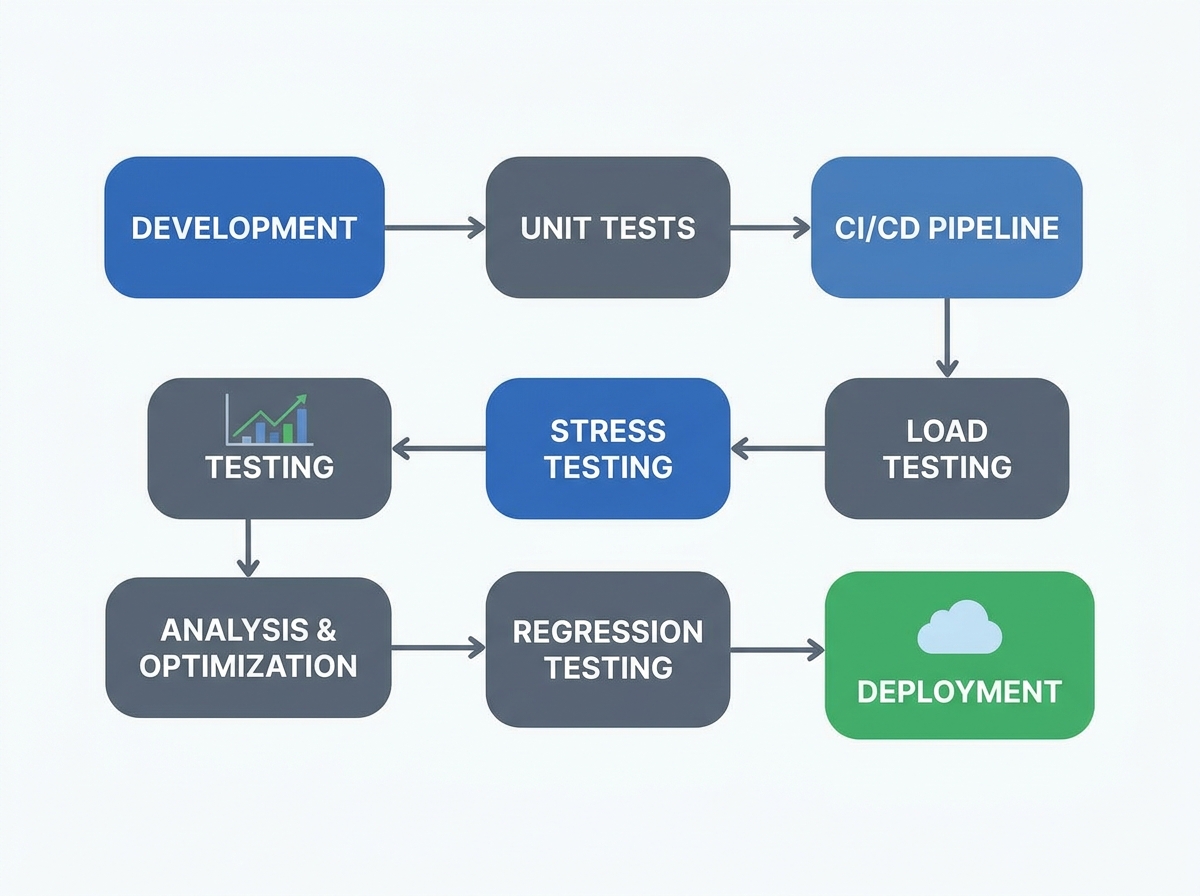
| Performance Testing Frequency | Manual, pre-launch only | Automated, integrated into CI/CD |
The “before” scenario follows mobile-first principles but skips systematic performance testing, resulting in unnoticed bottlenecks and lower retention. The “after” scenario integrates automated testing, catching issues early and ensuring a faster, more reliable experience for users.
Integrating Performance Testing into Mobile-First Workflows
Mobile-first businesses operate in a world where 5.78 billion people use mobile devices. When app performance lags, users leave, revenue drops, and brand reputation suffers. The companies that succeed embed performance testing into their agile and CI/CD workflows, making it a continuous process rather than a late-stage check.
Shift-Left and Continuous Feedback
The shift-left approach means testing early and often, catching bottlenecks before they reach users. By integrating performance testing into every sprint, teams create a feedback loop that speeds improvement. Automated tools provide actionable data as soon as code is merged, allowing engineers to address issues before release.
| Before | After |
|---|---|
| Release cycles are infrequent. Performance testing is manual and only done before major launches. Issues like slow startup or freezes on older devices are often discovered by users, leading to negative reviews and urgent fixes. | Releases are frequent. Automated performance tests run with every build, flagging slowdowns early. Engineers receive alerts for performance regressions during code review, reducing the need for hotfixes and improving user satisfaction. |
Integrating performance testing for mobile-first businesses is not just a technical upgrade – it’s an operational shift that turns speed and reliability into lasting advantages.
Choosing the Right Tools for Mobile Performance Testing
Open-Source Solutions
Open-source tools like Apache JMeter, JMeter DSL, and k6 offer flexibility and control for performance testing mobile-first businesses. These tools allow teams to craft complex test scenarios, simulate various mobile conditions, and integrate with CI/CD pipelines. JMeter supports detailed load testing, JMeter DSL enables code-based test creation, and k6 provides a modern scripting model with strong automation support.
The main trade-off is maintenance. Open-source solutions require infrastructure setup, regular updates, and in-house expertise to interpret results and keep tests relevant. For teams with technical resources, they provide deep customization.
Cloud-Based Platforms
Cloud-based platforms such as LoadFocus simplify performance testing by offering scalable infrastructure and real-time insights. These platforms can simulate user patterns from multiple regions and network conditions, making it easier to identify issues that only appear under specific circumstances. Integration with CI/CD pipelines supports continuous testing, and the operational overhead is reduced compared to self-hosted solutions.
The trade-off is less granular control and ongoing subscription costs. For many teams, the convenience and scalability outweigh these limitations.
| Tool | Type | Strengths | Limitations |
|---|---|---|---|
| Apache JMeter | Open-Source | Flexible scripting, wide protocol support, active community | Steep learning curve, local setup, ongoing maintenance |
| JMeter DSL | Open-Source | Code-based test creation, easy versioning, CI/CD integration | Requires developer expertise, infrastructure setup |
| k6 | Open-Source | Modern scripting, CLI/cloud execution, strong automation | Limited protocol support, scripting skills required |
| LoadFocus | Cloud-Based | Real-time dashboards, multi-region load, easy integration | Less granular customization, subscription cost |
The choice depends on your team’s need for control versus convenience. Open-source tools offer deep customization, while cloud platforms provide scalability and ease of use.
Common Challenges in Mobile Performance Testing
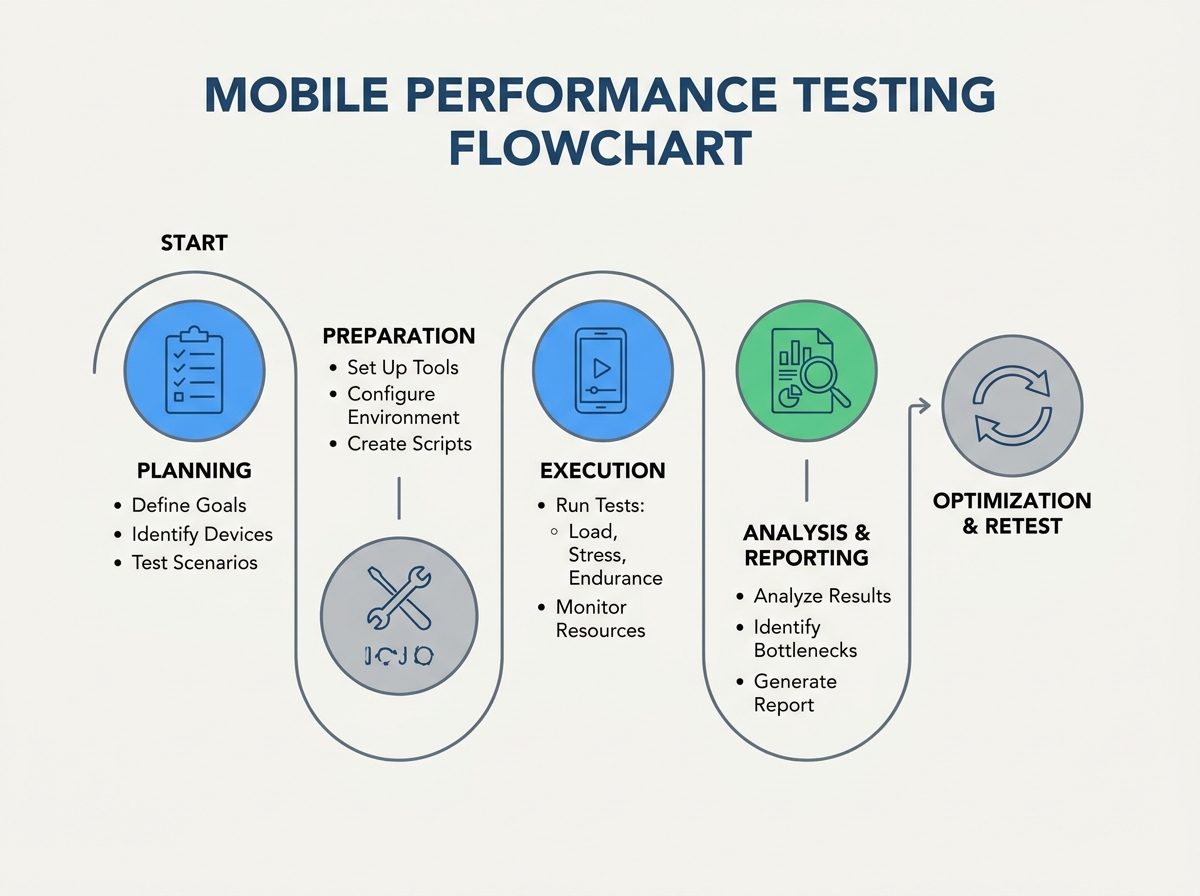
For mobile-first businesses, performance testing is essential but not always straightforward. The main challenge is complexity: testing must account for a wide range of devices, networks, and user behaviors. Specialized expertise and ongoing investment are often required.
Bridging the Skills Gap
Performance testing demands technical skills – from scripting tests to analyzing results and understanding network protocols. Many teams lack the time or expertise to extract actionable insights from test data. Options include targeted training for staff or using managed performance testing services, which can speed maturity and reduce the risk of costly errors.
Ensuring Real-World Accuracy
Simulating the unpredictable world of mobile users is challenging. Device diversity, OS fragmentation, and inconsistent networks can cause lab results to diverge from real user experiences. Leading teams use cloud-based platforms to mimic real network conditions and a range of devices, but real-world feedback through analytics and manual field testing remains essential.
Performance testing for mobile-first businesses is an ongoing process, requiring technical investment, smart tooling, and a willingness to challenge assumptions about user experience.
Strategic Takeaways for Mobile-First Leaders
Early Adopters Set the Pace
For mobile-first businesses, performance testing is now a core differentiator. Companies that prioritize rigorous testing are already seeing measurable gains in retention and revenue. With billions of mobile users, even modest improvements in speed and reliability can yield significant business benefits.
Continuous performance testing helps identify and resolve issues before they affect users, leading to higher app store ratings, lower support volumes, and improved conversion rates.
Continuous Testing Will Define Market Leaders
Looking ahead, the gap between businesses that embrace continuous performance testing and those that do not will widen. Brands with mature, integrated testing pipelines will dominate user satisfaction benchmarks. As performance becomes a baseline expectation, leaders will focus on further optimizing for speed and reliability across all devices and networks.
Performance Is the New Differentiator
Clever features and attractive UI can no longer compensate for poor performance. Today, competitive differentiation in mobile is built on speed, resilience, and real-world usability. Brands investing in sophisticated performance testing – whether through open-source frameworks or cloud platforms – are best positioned for long-term success.
The investment in expertise and infrastructure pays off by future-proofing your business and building a reputation for reliability in a mobile-first world.
Frequently Asked Questions
What is performance testing for mobile-first businesses?
Performance testing for mobile-first businesses involves evaluating how mobile apps and websites perform under real-world conditions – different devices, network strengths, operating systems, and app versions. The goal is to ensure every user, regardless of device or connection, experiences a fast and reliable app. With 5.78 billion unique mobile users worldwide as of October 2025, optimizing for mobile performance is critical for retention and growth.
Why is performance testing especially important for mobile-first businesses?
Mobile-first companies depend on mobile engagement for growth. Even a brief delay can cost users. The large share of the global population using mobile devices means expectations for speed are higher than ever. Mobile platforms introduce complexity – device diversity, unpredictable connectivity, and strict resource constraints. If users encounter slow or unresponsive screens, they’re likely to leave the app entirely.
What are the unique challenges of mobile performance testing?
- Device Fragmentation: Ensuring consistent performance across many device models and hardware specs is a major challenge.
- Variable Network Conditions: Users move between Wi-Fi, 4G, 5G, and slow hotspots. Testing must account for these fluctuations.
- OS and App Versioning: Supporting multiple versions of Android and iOS, plus evolving app releases, requires broad test coverage.
- Resource Constraints: Limited battery, CPU, and memory on mobile devices demand careful optimization.
Missing any of these can result in issues that only appear under certain conditions, leading to negative reviews or user churn.
How does mobile-first design impact performance testing?
Mobile-first design means building for the mobile experience first, then scaling up for larger screens. This approach prioritizes essential content and streamlined layouts. For performance testing, it means focusing on critical mobile flows and simulating touch interactions, scrolling, and navigation unique to mobile users. When combined with targeted testing, mobile-first design leads to faster, more resilient apps.
What tools are best for performance testing mobile-first businesses?
Open-source tools like Apache JMeter, JMeter DSL, and k6 are widely used for their flexibility and integration capabilities. For teams seeking simplicity, platforms like LoadFocus offer cloud-based solutions that streamline test setup and monitoring. The best tool depends on your team’s skills, scale, and workflow needs.
How can we integrate performance testing into our workflow?
- Start Early: Include performance testing from the first development sprints.
- Automate: Integrate tests into CI/CD workflows for continuous feedback.
- Test Realistic Scenarios: Simulate actual user journeys, device types, and network speeds.
- Iterate: Use performance results to guide improvements before release.
Teams that build a feedback loop between development and testing see fewer surprises and better user experiences.
What’s the biggest piece of advice for mobile-first teams starting performance testing?
Begin with small, targeted tests and expand as you learn. Early wins help build momentum and keep performance visible to the whole team. As your mobile presence grows, prioritize continuous, rigorous testing to retain users and stay ahead of competitors.
{“@context”:”https://schema.org”,”@type”:”FAQPage”,”mainEntity”:[{“@type”:”Question”,”name”:”What is performance testing for mobile-first businesses?”,”acceptedAnswer”:{“@type”:”Answer”,”text”:”Performance testing for mobile-first businesses involves evaluating how mobile apps and websites perform under real-world conditions – different devices, network strengths, operating systems, and app versions. The goal is to ensure every user, regardless of device or connection, experiences a fast and reliable app. With 5.78 billion unique mobile users worldwide as of October 2025, optimizing for mobile performance is critical for retention and growth.”}},{“@type”:”Question”,”name”:”Why is performance testing especially important for mobile-first businesses?”,”acceptedAnswer”:{“@type”:”Answer”,”text”:”Mobile-first companies depend on mobile engagement for growth. Even a brief delay can cost users. The large share of the global population using mobile devices means expectations for speed are higher than ever. Mobile platforms introduce complexity – device diversity, unpredictable connectivity, and strict resource constraints. If users encounter slow or unresponsive screens, they’re likely to leave the app entirely.”}},{“@type”:”Question”,”name”:”What are the unique challenges of mobile performance testing?”,”acceptedAnswer”:{“@type”:”Answer”,”text”:”Missing any of these can result in issues that only appear under certain conditions, leading to negative reviews or user churn.”}},{“@type”:”Question”,”name”:”How does mobile-first design impact performance testing?”,”acceptedAnswer”:{“@type”:”Answer”,”text”:”Mobile-first design means building for the mobile experience first, then scaling up for larger screens. This approach prioritizes essential content and streamlined layouts. For performance testing, it means focusing on critical mobile flows and simulating touch interactions, scrolling, and navigation unique to mobile users. When combined with targeted testing, mobile-first design leads to faster, more resilient apps.”}},{“@type”:”Question”,”name”:”What tools are best for performance testing mobile-first businesses?”,”acceptedAnswer”:{“@type”:”Answer”,”text”:”Open-source tools like Apache JMeter, JMeter DSL, and k6 are widely used for their flexibility and integration capabilities. For teams seeking simplicity, platforms like LoadFocus offer cloud-based solutions that streamline test setup and monitoring. The best tool depends on your team’s skills, scale, and workflow needs.”}},{“@type”:”Question”,”name”:”How can we integrate performance testing into our workflow?”,”acceptedAnswer”:{“@type”:”Answer”,”text”:”Teams that build a feedback loop between development and testing see fewer surprises and better user experiences.”}},{“@type”:”Question”,”name”:”What’s the biggest piece of advice for mobile-first teams starting performance testing?”,”acceptedAnswer”:{“@type”:”Answer”,”text”:”Begin with small, targeted tests and expand as you learn. Early wins help build momentum and keep performance visible to the whole team. As your mobile presence grows, prioritize continuous, rigorous testing to retain users and stay ahead of competitors.”}}]}