Create New Website Performance Test
Run a new website performance test with LoadFocus
Open Website Performance Monitors and click New Test (or Create New, then Test). Fill in the form, then run the test now or save it for later.
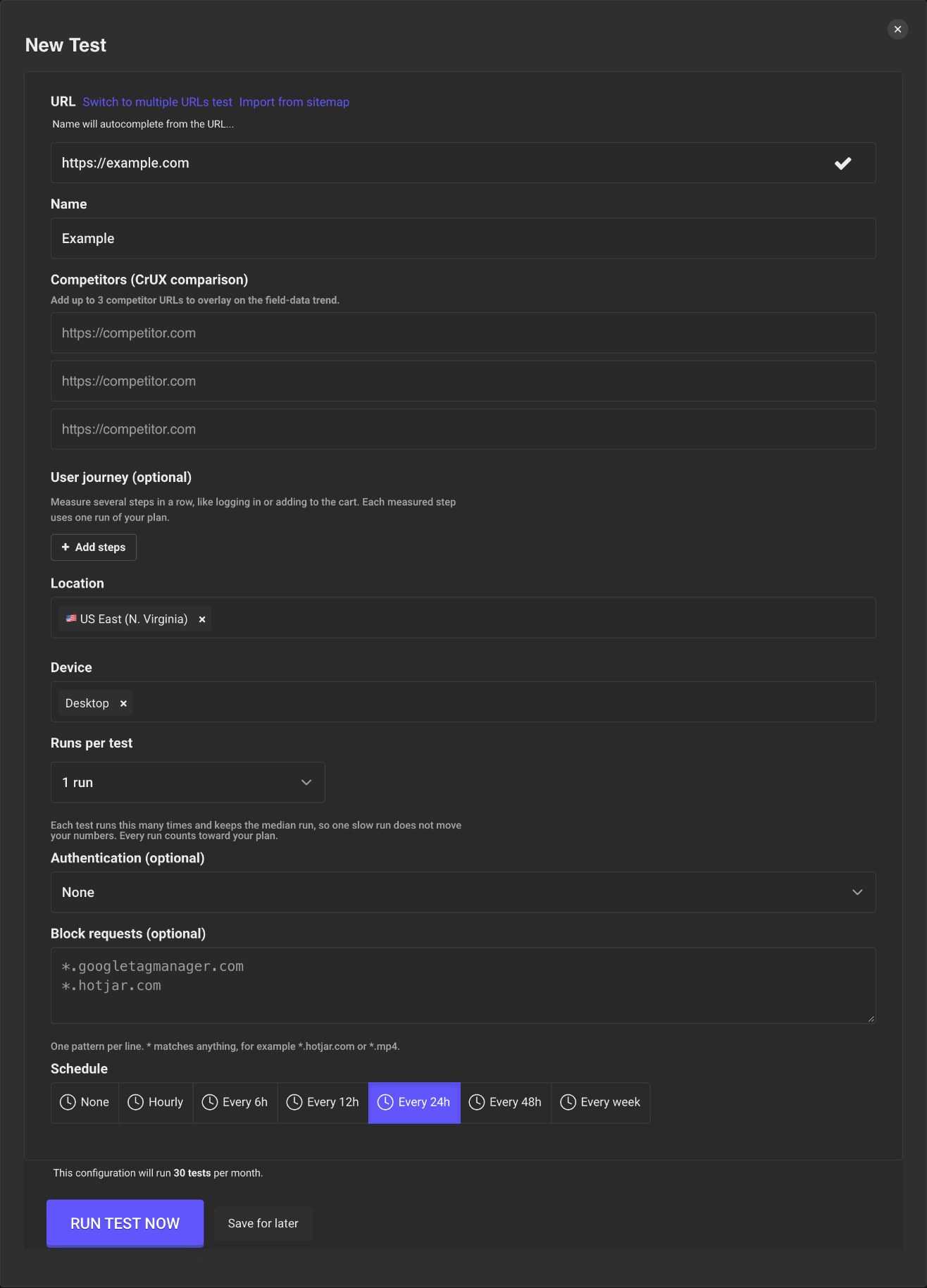
Steps to configure a new website performance monitor
1. URL
Enter the web page you want to test, for example https://example.com. To add several pages at once, use Switch to multiple URLs test or Import from sitemap (see Import URLs from your sitemap).
2. Name
The name fills in from the URL. Change it if you want something more readable.
3. Competitors
Optional. Under Competitors (CrUX comparison), add up to 3 competitor URLs. Their real-user Core Web Vitals are drawn over yours on the field-data trend. See Core Web Vitals Competitor Comparison.
4. User journey
Optional. Under User journey (optional), click Add steps to measure several steps in a row, like logging in or adding to the cart. Each measured step uses one run of your plan. Test flow tries the steps before you save. Competitors and journeys are available on single URL tests.
5. Location
The location is the geographical region the test runs from. See all locations; to allow-list the test traffic, see whitelisting IPs.
6. Device
Choose Mobile, Desktop or both. This simulates loading the page on that kind of device.
7. Runs per test
Run each test 1, 3 or 5 times and keep the median run. See Runs per test below.
8. Authentication
If the page is behind a login, fill in Authentication (optional) with Basic Auth, a Bearer Token, a Custom Header or Cookies. See HTTP authentication.
9. Blocked requests
Optional. Under Block requests (optional), list the requests to block during the audit, for example analytics, chat widgets or A/B testing scripts. Use one pattern per line, up to 20; * matches anything, for example *.hotjar.com.
10. Schedule
Choose how often the monitor runs again:
- None
- Hourly
- Every 6h
- Every 12h
- Every 24h (selected by default)
- Every 48h
- Every week
Hourly, Every 6h and Every 12h need a paid plan.
11. Run it
Click Run Test Now to start a run immediately, or Save to keep the configuration without running it.
Runs per test
Lab results vary a little from run to run: the network, the server and third-party scripts are never exactly the same twice. Below Device, Runs per test runs each test 1, 3 or 5 times and keeps the median run, the one closest to the middle First Contentful Paint and Largest Contentful Paint. The report, scores, history and alerts all use that run, so one slow run does not move your numbers or trigger an alert.
On the result page, Median of 3 runs lists every run with its numbers and marks the median one. A run that failed is shown and left out.
Every run counts toward your plan, so 3 runs per test use three runs each time the test runs. A test with a user journey always runs once, because each measured step already counts as a run. If you gate CI builds on a monitor with 5 runs, give the CI script a longer --timeout.
Add an alert
Alerts fire each time a scheduled test runs. To add one for a test, click Add monitor in its row on the Tests page. More in Create a new alert.
For step types, secret steps and limits, see User journeys. To understand what a finished run shows, see Reading a Page Speed result.