

Datadog Integration
How to Activate the Datadog Integration
Section titled “How to Activate the Datadog Integration”Send the metrics of your cloud, JMeter and k6 load tests to Datadog while the test runs, so you can see them next to the rest of your monitoring data.
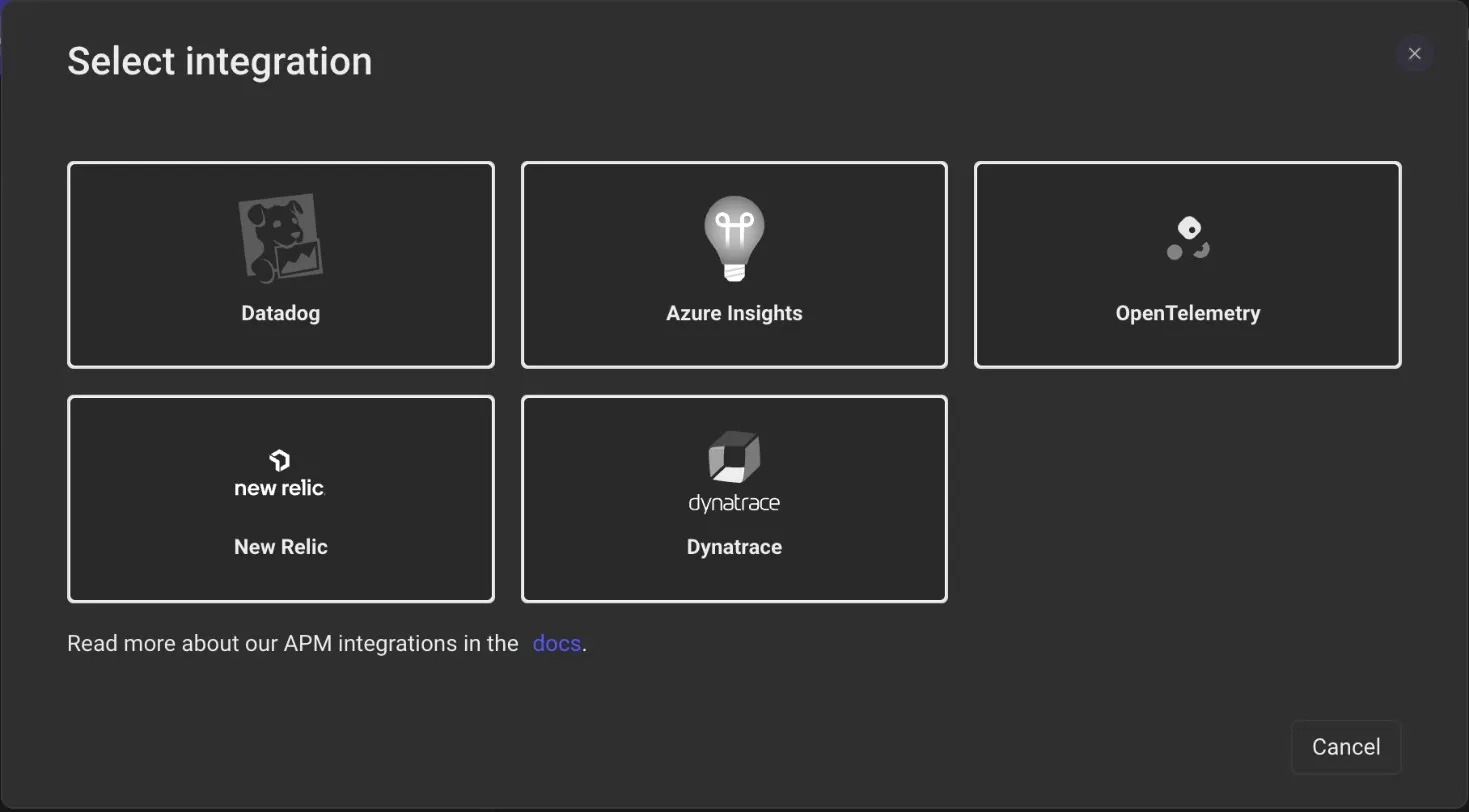
- In LoadFocus, open the new-test or edit-test page and find the integrations row (Send results to Datadog, New Relic…).
- Click Manage integrations, add a new Datadog integration and save it. You can also manage integrations from account settings under Integrations.
- Back on the test, pick the Datadog integration in the Integrations select and save the test.
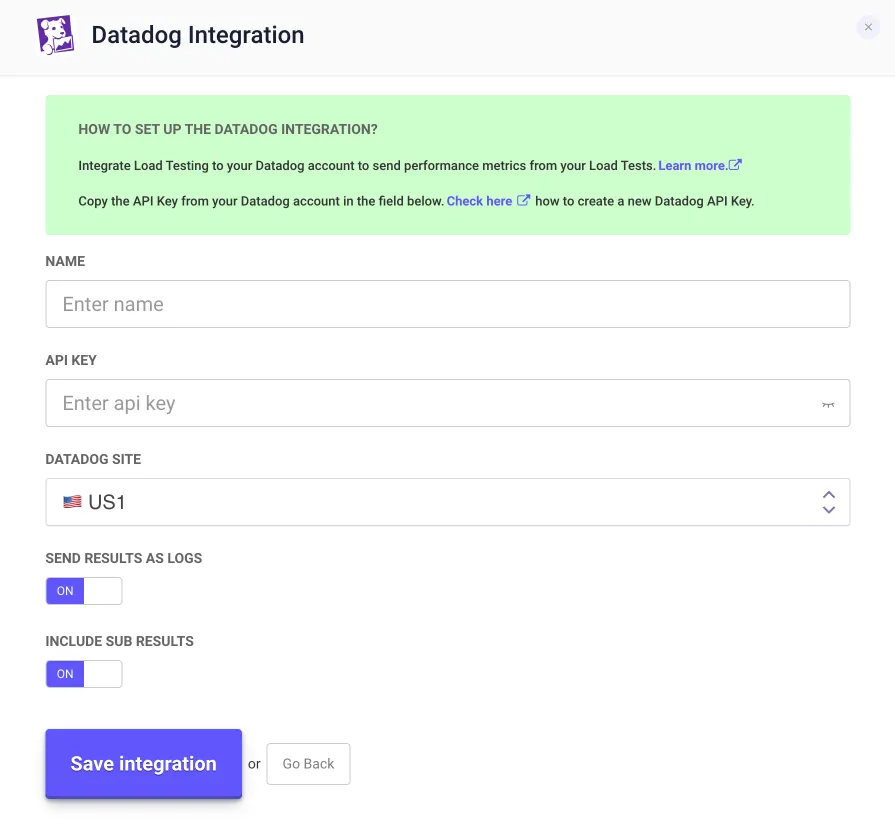
Integration Fields
Section titled “Integration Fields”- Name: A name to recognise the integration by.
- API Key: Your Datadog API key.
- Datadog SITE: The region of your Datadog account: US1, US3, US5, EU, AP1 or US1-FED.
- Send Results as Logs: Also send each result to Datadog as a log event. On by default. JMeter tests only.
- Include Sub results: Also send sub-results. On by default. JMeter tests only.
k6 tests send metrics only, so the two switches above do not apply to them. k6 sends them over OpenTelemetry (OTLP) with k6's standard names, such as http_reqs and http_req_duration. Rate metrics such as http_req_failed and checks arrive as one counter each, http_req_failed.total and checks.total, with a condition attribute that is nonzero for a failed request (or a passed check) and zero otherwise; divide the nonzero count by the total to get the rate. Before k6 v2.3.0 (November 2026) they came as two counters, .occurred and .total, so update any dashboard or query built on .occurred.
To create a Datadog API key, see Datadog's API key documentation. Copy the key when it is shown, Datadog does not show it again.
Use One Integration Per Setup
Section titled “Use One Integration Per Setup”If different tests need different Datadog settings (for example one account or site for some tests and another for the rest), create one integration for each setting and select the right one on each test.
See the Data in Datadog
Section titled “See the Data in Datadog”Once a test that uses the integration runs, its metrics arrive in your Datadog account. Build your own dashboard there to put them next to system metrics such as CPU and memory. If you turned on Send Results as Logs, use the Datadog Log Explorer to filter individual results, for example error responses or slow requests.
Removing the Datadog Integration
Section titled “Removing the Datadog Integration”- Open account settings and go to Integrations.
- Click the delete icon on the Datadog integration.