

How to Run a New Apache JMeter Load Test
Run a new Apache JMeter Load Test with LoadFocus
Section titled “Run a new Apache JMeter Load Test with LoadFocus”Open the New JMeter Test page (you need to be logged in), upload your JMX script, set the load and the locations, and click Run test. LoadFocus runs the script in the cloud on Apache JMeter 5.6.2.
For an overview of the service (regions, plans, how runs are scaled), see JMeter cloud load testing. New to JMeter itself? The JMeter load testing tutorial shows how to build and check a test plan before you upload it.
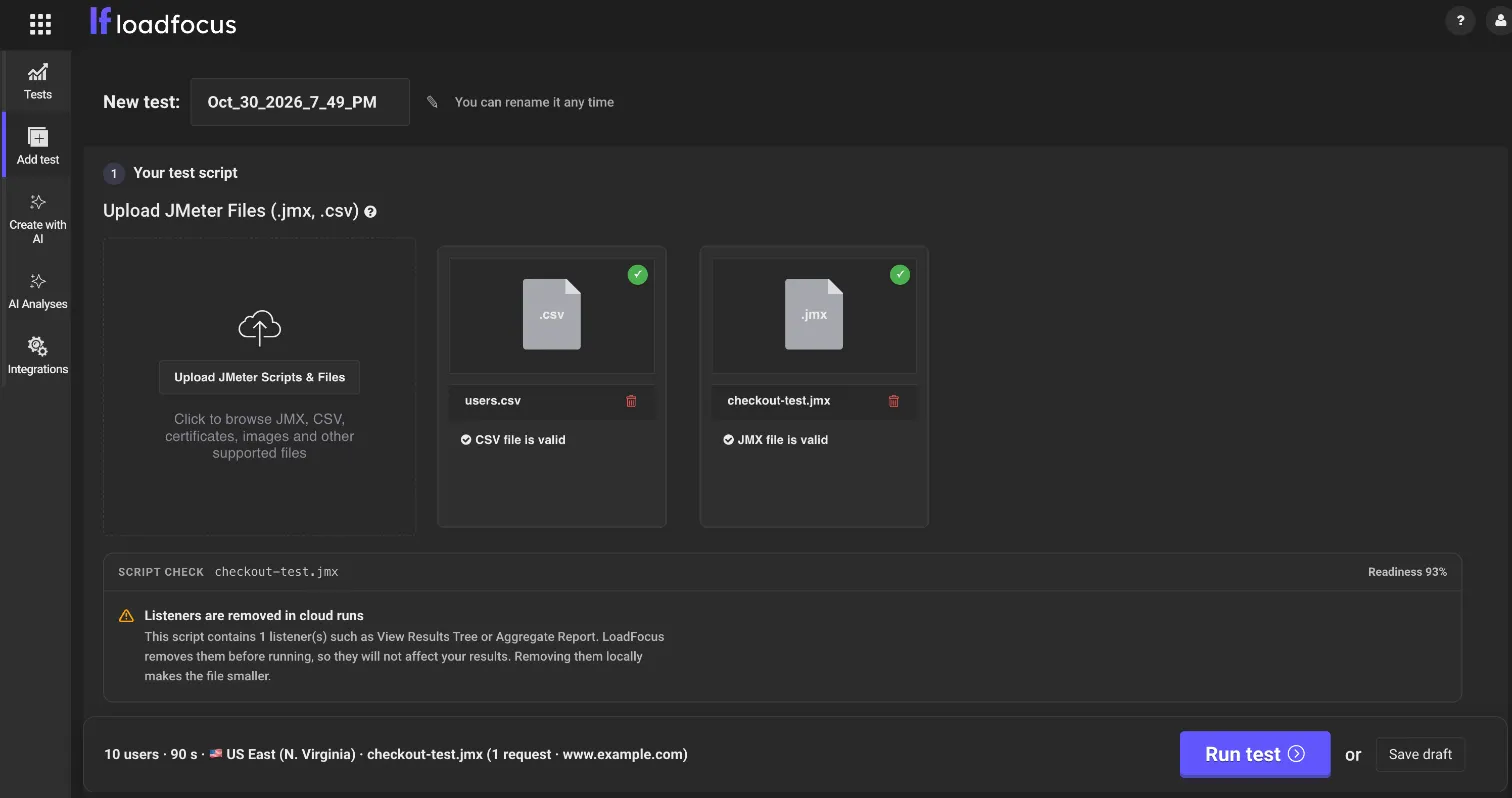
Steps to Configure a New Load Test
Section titled “Steps to Configure a New Load Test”The page has three numbered steps (1 Your test script, 2 How much load?, 3 Where from?), a More options section and a bar at the bottom with the run button.
Test name
Section titled “Test name”We automatically generate a test name using the current date and time. It sits at the top of the page, after New test:. Click the name or the pencil icon to change it. You can rename the test at any time.

1. Your test script
Section titled “1. Your test script”In step 1 Your test script, upload exactly one JMX script per test, plus any data files it reads (for example CSV files). You can drag and drop files into the upload area or click Upload JMeter Scripts & Files. A test can hold up to 10 files, each up to 100 MB. Besides .jmx and .csv, you can upload .txt, certificates (.cer, .crt, .pem, .pfx, .p12, .asc) and images (.jpg, .jpeg, .png, .gif). A test runs one .jmx file, so a new .jmx replaces the one already there.
No script yet? Under the upload area, Import from cURL, HAR, Postman or OpenAPI turns an existing request into a .jmx (see Import to JMeter), and Describe it and let AI write it opens the AI test generator. See Create a load test with AI.
You can also record a script. The LoadFocus JMeter Chrome extension records the pages you visit in Chrome and saves them as a .jmx file that you can edit, download and upload here. On a paid plan or during a trial it can also run the recording in the cloud straight from the extension.
If a large test runs on more than one load generator (the page counts them as JMeter engines), upload a different CSV file for each one. See using multiple CSV files with JMeter engines.
JMeter script validation
Section titled “JMeter script validation”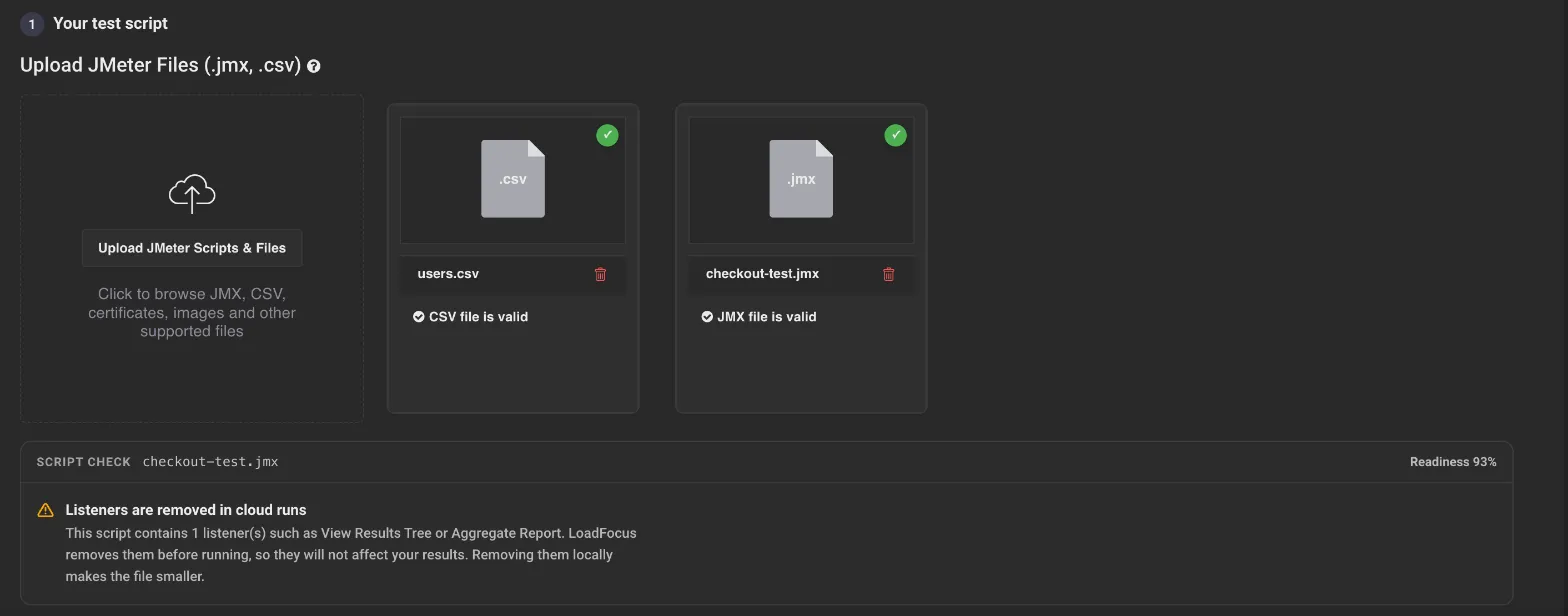
- Every
.jmxfile is checked when you upload it, and problems are shown straight away in the Script check panel. - The check catches broken files and scripts that would skip steps at run time, such as a Module Controller that points at an element that is not in the file.
- It also tells you that listeners are removed in cloud runs, so they do not affect your results.
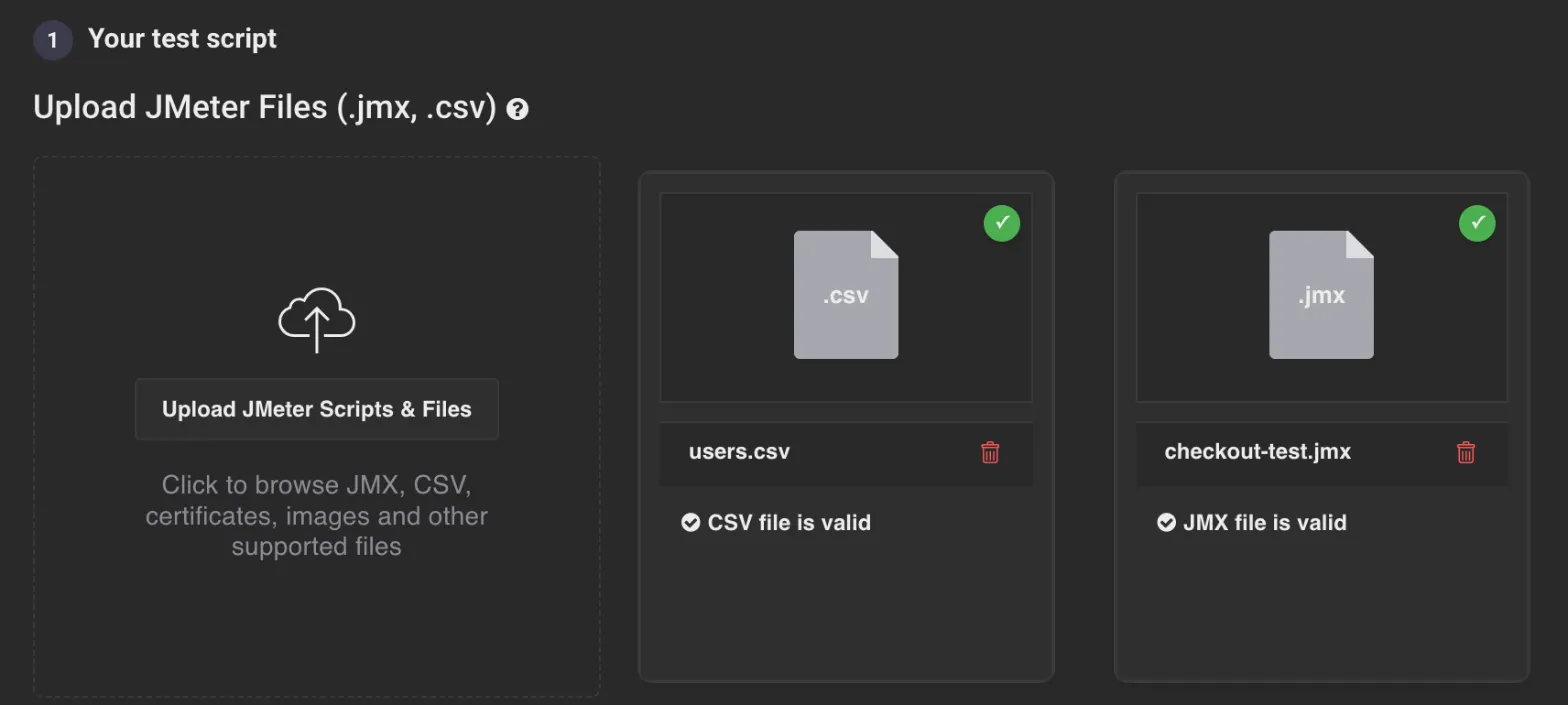
More on uploading: Uploading JMeter files.
2. How much load?
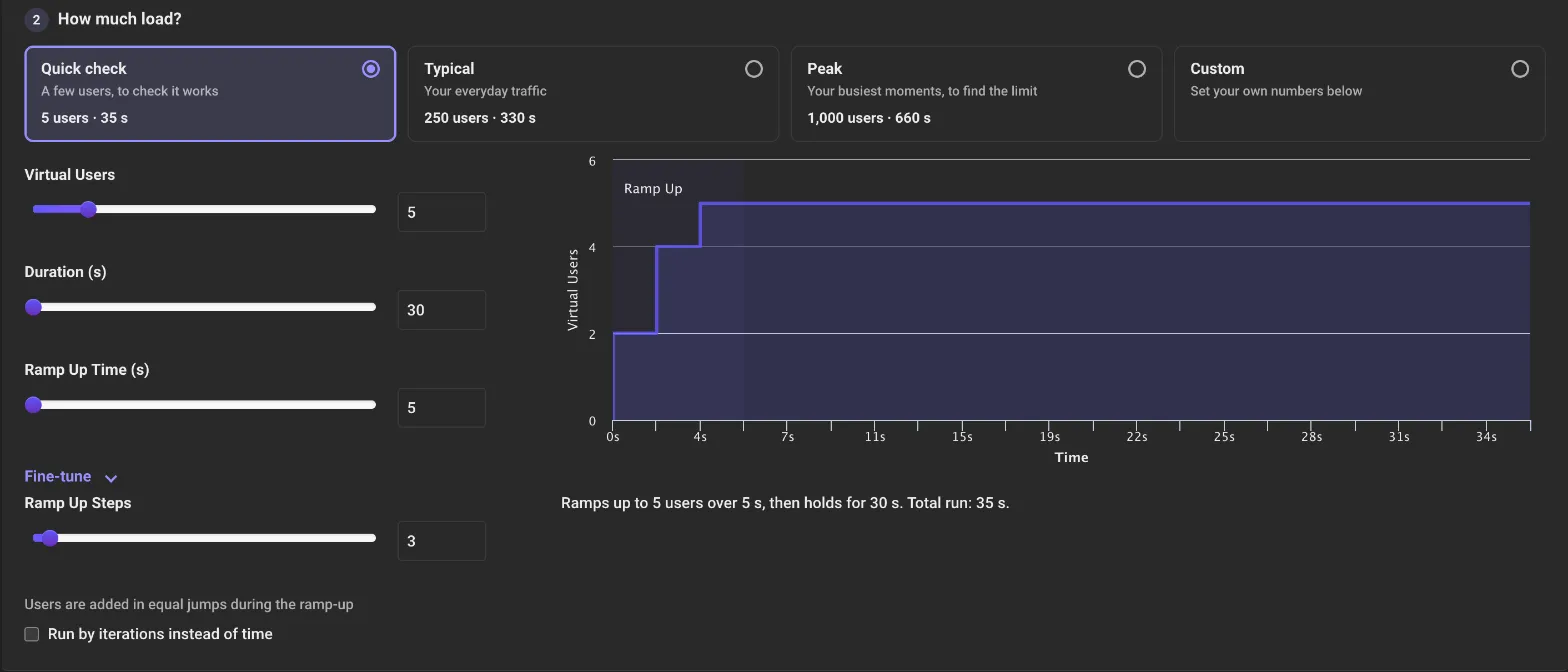
Section titled “2. How much load?”Step 2 How much load? starts with four presets:
- Quick check: a few users, to check it works.
- Typical: your everyday traffic.
- Peak: your busiest moments, to find the limit.
- Custom: set your own numbers below.
Each preset card shows the users and the total run time it sets, within the limits of your plan. Click one to fill in the configuration, then adjust it if you like.

Virtual users, duration and ramp-up
Section titled “Virtual users, duration and ramp-up”Under the presets you define:
- Virtual Users
- Duration (s)
- Ramp Up Time (s)
Open Fine-tune for Ramp Up Steps, for Run by iterations instead of time (which swaps Duration (s) for Iterations) and for Switch time units: seconds ↔ minutes for duration and ramp-up. The chart shows how the ramp up and the overall duration will look, and the line under it sums up the run. The sliders stop at the limits of your plan.
On the Free plan, runs are also limited per day and per website: see Limits on the Free plan.
3. Where from?
Section titled “3. Where from?”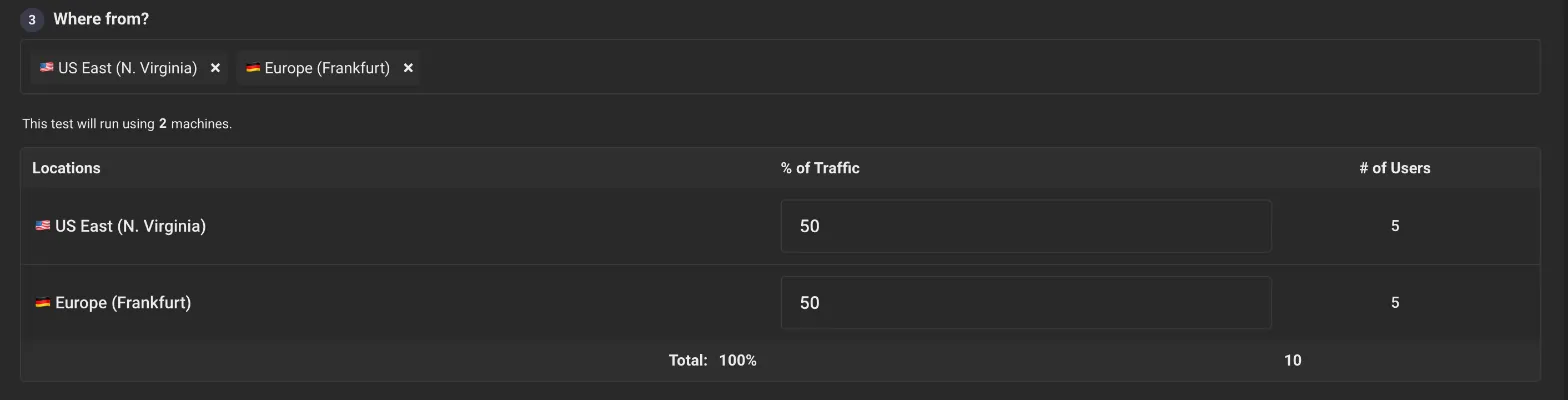
In step 3 Where from?, pick the locations the load comes from (Add Location adds another one). Every location gets a % of Traffic, and LoadFocus works out the # of Users for it from your total. The percentages must add up to 100%. For example, with 5,000 virtual users split evenly over five locations:
- US East (N. Virginia): 20% (1,000 users)
- Canada (Central): 20% (1,000 users)
- Europe (London): 20% (1,000 users)
- Asia Pacific (Hong Kong): 20% (1,000 users)
- US West (N. California): 20% (1,000 users)
Testing from several locations at once needs a Pro or Enterprise plan; other plans use one location. See all locations, and use this guide if you need to whitelist IPs.
Running the JMeter Test and Inspecting Results
Section titled “Running the JMeter Test and Inspecting Results”Click Run test in the bar at the bottom of the page and confirm in the Run this test? dialog, or click Save draft to keep the configuration for later. If something is missing, the bar says what after Can't run yet:. Under More options you can also add Pass/fail checks, Run on a schedule and Send results to Datadog, New Relic… before you run.
Once the test is complete, you can:
- View overall performance metrics in the Overview tab.
- Switch on View per location to see how each region performed.
- Inspect errors, response times, hits/s, and more in the detailed results tabs.
For more on reading the results, see the Load Test Results guide.