Key Takeaways
Actionable Insights for Practitioners
AI-driven load testing approaches have become practical tools for performance teams in 2026. By learning from real user data, these methods now reduce manual effort significantly. According to LoadTest Analytics, teams can see up to a 60% reduction in test creation time. More importantly, AI-driven testing uncovers edge cases that scripted approaches often miss, broadening coverage and helping teams better capture the range of user behaviors under load.
However, scripted tests remain essential for scenarios requiring precise, repeatable control. Industries with compliance requirements or teams that must validate known regression paths should not abandon scripted methods. Scripted tests offer unmatched transparency and are still the default for performance baselining and regulatory validation. For a deeper breakdown of traditional and emerging test strategies, see our guide on e-commerce load testing strategies.
Is Your Infrastructure Ready for Global Traffic Spikes?
Unexpected load surges can disrupt your services. With LoadFocus’s cutting-edge Load Testing solutions, simulate real-world traffic from multiple global locations in a single test. Our advanced engine dynamically upscales and downscales virtual users in real time, delivering comprehensive reports that empower you to identify and resolve performance bottlenecks before they affect your users.
The Case for a Hybrid Approach
The most effective organizations blend both approaches – a hybrid model. Use AI-driven tools to automatically generate and adapt scenarios, then anchor your test suite with targeted scripted tests for compliance or complex workflows. This combination maximizes both coverage and control. When integrating performance testing with DevOps workflows, as highlighted in our DevOps integration guide, hybrid load testing approaches are proving especially effective.
- Choose your strategy based on project stage, regulatory needs, and your team’s expertise – not just on tool features.
- Automate existing scripted tests where possible, but retain manual scripts for high-risk or regulated scenarios.
- Continuously feed AI-driven test models with live user data to keep them relevant.
The most effective load testing approaches in 2026 are those that adapt to your business context, regulatory landscape, and team skillset. Start with your needs – then choose, combine, and iterate.
Fishing with a Spear or a Net? The Core Difference in Load Testing Approaches
Picture yourself at the edge of a river, choosing your fishing tool. Scripted load testing is like fishing with a spear: you know exactly where you’re aiming and what you want to catch. Every move is deliberate, every outcome expected. In contrast, AI-driven load testing works more like casting a wide net. The net adapts to the current, catching not just what you set out for, but also what you didn’t anticipate – sometimes revealing surprises you would have missed with a spear.
Think your website can handle a traffic spike?
Fair enough, but why leave it to chance? Uncover your website’s true limits with LoadFocus’s cloud-based Load Testing for Web Apps, Websites, and APIs. Avoid the risk of costly downtimes and missed opportunities—find out before your users do!
Why This Metaphor Matters in 2026
The distinction isn’t just poetic. For decision-makers in cloud and performance engineering, the choice between these load testing approaches directly impacts test coverage, resource allocation, and readiness for the unpredictability of modern infrastructure. With cloud-native architectures, microservices, and real-time scalability, the stakes are higher than ever. Teams must ensure their applications withstand not only the expected, but also the unexpected surges and behaviors that real users bring. Gartner’s 2024 analysis suggests that over 40% of load testing activities now involve some AI elements – far more than just a few years ago.
Spear Fishing: Scripted Load Testing
Scripted approaches deliver control and repeatability. You define every user journey, every parameter, every data point. This precision is essential for regulatory compliance, regression cycles, and when you need to prove exactly how a system responds to specific scenarios. But there’s a tradeoff: creating and maintaining these scripts comes at a steep cost. The average complex scenario takes 30-40 hours to script and must be revisited every time the application changes. If you’re operating in a highly regulated sector or need clear audit trails, this method remains essential. For a detailed breakdown of where scripted testing shines, see these e-commerce performance strategies.
Casting the Net: AI-Driven Load Testing
AI-driven load testing is built for adaptability. Machine learning models consume real user data, evolve with your application, and uncover edge cases that scripted tests might never cover. According to LoadTest Analytics, these approaches can cut test creation time by 60% and highlight issues hidden from even seasoned performance engineers. The net adjusts automatically as the river changes – mirroring how AI-based tools adapt to shifting user patterns and new code deployments. This is especially valuable for teams adopting continuous integration and delivery, where application updates are constant. For more on how AI is changing cloud testing, check out this analysis of serverless trends.
Choosing between a spear and a net isn’t just about preference; it’s important to understand your environment and your goals. In 2026, the best-prepared teams use both tools with intent – targeting high-value scenarios with scripts and broadening their safety net with AI. That’s how you stay ready for whatever the current brings.
LoadFocus is an all-in-one Cloud Testing Platform for Websites and APIs for Load Testing, Apache JMeter Load Testing, Page Speed Monitoring and API Monitoring!
At a Glance: Scripted vs AI-Driven Load Testing Approaches
Comparing the Core Dimensions
When it comes to load testing approaches, there’s a clear divide between traditional scripted tests and the newer, AI-driven methods. Teams weighing their options need to consider several practical dimensions: from the hands-on effort required to set up and maintain tests, to how well each method adapts as applications change. Below is a structured comparison, giving you a snapshot of what to expect from each approach.
| Dimension | Scripted Load Testing | AI-Driven Load Testing |
|---|---|---|
| Setup Effort | Significant manual scripting. Typical enterprise scenario takes 30-40 hours to build and debug, especially for complex user journeys. | Automated scenario generation cuts initial setup by up to 60% (per LoadTest Analytics 2023). Minimal manual work if user data is available. |
| Adaptability | Scripts must be updated whenever the app changes, which can slow down agile teams. High friction in rapidly evolving products. | Adapts in real time using machine learning – AI models learn from production data and adjust scenarios to new behaviors on the fly. |
| Test Maintenance | Requires ongoing manual updates. Regression errors can slip through if scripts lag behind development. | Self-healing scripts detect changes and update themselves, reducing maintenance overhead. Some tuning may still be needed for edge cases. |
| Realism | Highly controlled, but limited to what was anticipated during scripting. Edge cases often missed. | Scenarios mirror real user patterns and surface unexpected behaviors. Broader coverage, especially under unpredictable loads. |
| Transparency | Full visibility into every step and logic branch, ideal for compliance and troubleshooting. | “Black box” concerns: AI decisions and test paths can be opaque, making root cause analysis challenging. |
| Scalability | Manual effort grows linearly with test complexity. Scaling to hundreds of user paths quickly becomes unmanageable. | AI can rapidly scale to thousands of user sessions, optimizing scenarios continuously. Requires strong infrastructure and sufficient training data. |
Scripted load testing excels in environments where precision, transparency, and regulatory compliance are top priorities. It’s the standard for industries that can’t risk ambiguity, such as finance or healthcare. For a step-by-step look at building high-fidelity scripts for complex user journeys, see this guide to data-driven scripting.
Meanwhile, AI-driven load testing stands out for its adaptability and efficiency. With the ability to learn from actual user data and evolve scenarios dynamically, it reduces manual work and uncovers issues that scripted tests often miss. As covered in this SaaS case study, teams using AI-based methods report faster detection of performance bottlenecks and broader scenario coverage – all without the tedium of constant script updates.
Choosing the right path involves understanding where each approach excels and matching your testing mix to your team’s needs and risks.
How Scripted Load Testing Works: Precision and Predictability
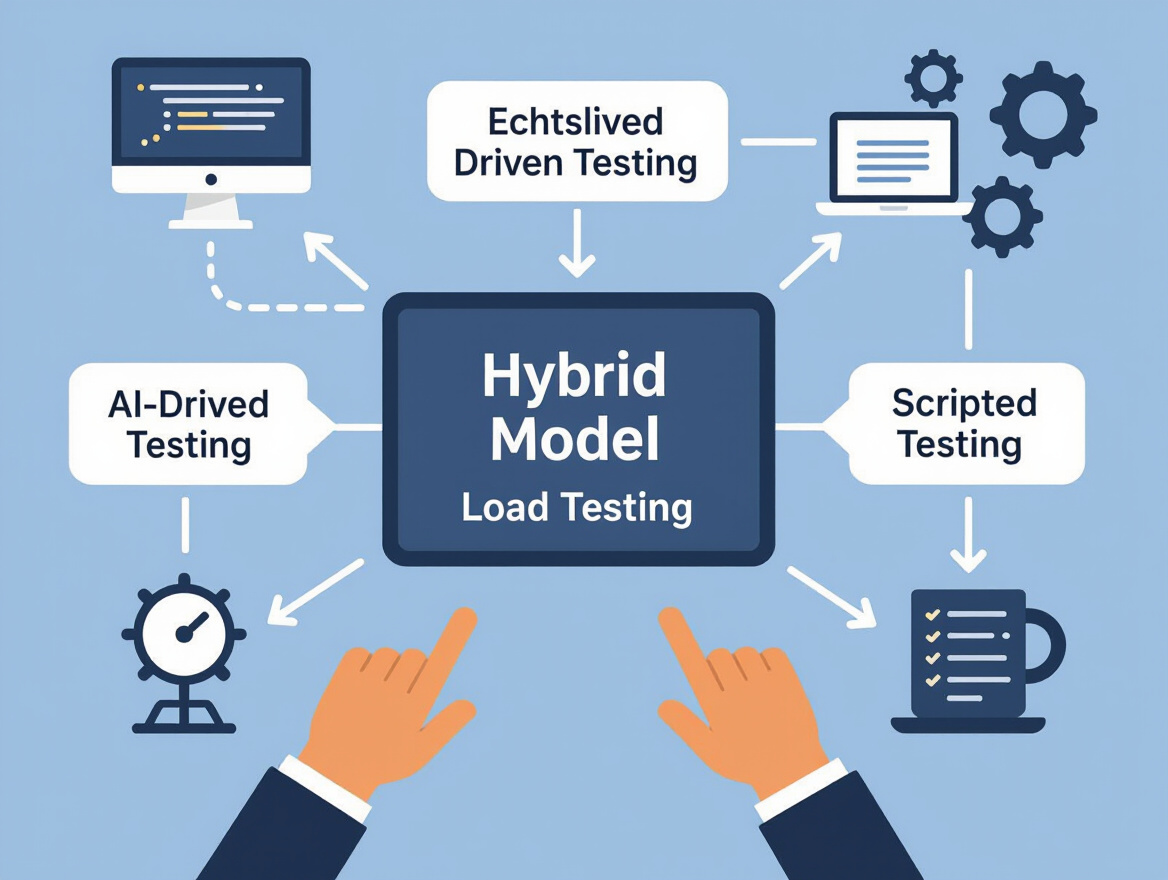
Traditional scripted load testing is still the foundation for many performance engineering teams, and for good reason. By manually crafting scripts that mimic specific user journeys, you get a level of precision and repeatability unattainable with more dynamic approaches. This is invaluable when your goal is to validate compliance, run regression tests, or establish baseline performance metrics for critical applications.
Key Insight: Scripted load tests deliver unmatched control and transparency, making them indispensable for regulated industries and repeatable performance baselines.
Strengths of Scripted Load Testing
The main advantage of scripted load testing lies in its granular control over test scenarios. You define exactly which user actions are simulated, under what conditions, and in what sequence. For example, a global payments provider might script a test where 10,000 virtual users log in, initiate a funds transfer, and then log out – step by step, just like their compliance auditor would expect. This level of specificity ensures that tests are repeatable and auditable, ticking boxes for everything from GDPR data privacy checks to PCI DSS payment flow validation.
These approaches also shine when dealing with regression and baseline performance validation. If your team is rolling out new features every sprint, scripted tests let you verify that nothing has regressed in core workflows. That’s why, as the e-commerce performance best practices for 2026 emphasize, maintaining a strong suite of scripted tests is essential for tracking trends over time, especially during high-stakes events like Black Friday.
Finally, when it comes to compliance, scripted tests are often non-negotiable. Healthcare, banking, and insurance sectors require proof that applications behave as intended under expected loads. Scripted scenarios provide that evidence and stand up to scrutiny during audits. For a deep-dive on advanced scripting, see How to Create Data-Driven Load Testing Scripts for Complex User Journeys (2026 Guide).
Limitations and Pain Points
Scripted load testing, for all its strengths, comes with real-world costs. The upfront investment is substantial: teams typically spend 30 to 40 hours scripting each complex scenario. This time adds up fast when your application evolves rapidly or integrates with third-party services.
Maintenance is a persistent headache. Every time your UI changes, a new API endpoint is added, or business logic shifts, scripts become brittle. Suddenly, that carefully constructed login workflow throws errors – or worse, silently drifts out of sync with production behavior. This creates a constant cycle of script upkeep that saps time from more strategic efforts. Many teams discover their scripts lag behind reality, especially in agile environments.
Perhaps most frustrating is limited adaptability. Scripted tests excel at what you tell them to do, but they rarely reveal unanticipated user journeys or edge cases. If a user clicks “forgot password” four times in a row, will your script catch the resulting load? Probably not. AI-driven approaches, discussed elsewhere, can fill that gap – but scripted tests stay static unless you manually expand them.
Before/After Examples: Script Coverage in Practice
| Before | After |
|---|---|
|
Generic Script: Simulates 1,000 users each logging in and browsing the homepage for 10 seconds. |
Specific Script: Simulates 1,000 users logging in, searching for a product, adding it to the cart, applying a discount code, and completing checkout – mirroring the precise funnel for a flash sale event. |
The improved script is better because it mirrors real business-critical user journeys and surfaces performance bottlenecks where they matter most, rather than just exercising generic site navigation.
For practitioners wrestling with these limitations, some are exploring hybrid models that combine scripted and dynamic approaches, as highlighted in this SaaS load testing case study. But for compliance, regression, and baselining, scripted load testing remains a core tool in the modern performance engineer’s kit – precise, predictable, and deeply relevant in 2026.
Inside AI-Driven Load Testing: Adaptability and Insight
AI-driven load testing approaches are changing how performance teams simulate, analyze, and optimize web and API traffic. Instead of relying solely on manually scripted test scenarios, machine learning models now generate dynamic, realistic test patterns that mirror actual user behavior. As a result, organizations can adapt their testing strategies on the fly, uncover deep system insights, and reduce the overhead of ongoing script maintenance.
Key Insight: AI-driven load testing excels at surfacing hidden performance issues through continuous adaptation to real-world user patterns – something scripted tests rarely achieve at scale.
Key Capabilities of AI-Driven Load Testing
The most compelling advantage of AI-driven approaches is continuous learning from production traffic. These tools observe how real users interact with your application, then use that data to generate or refine test scenarios. This means you’re not guessing at potential bottlenecks – you’re actively testing the edge cases your users actually encounter. AI-driven tools can reduce test creation time by up to 60% compared to traditional scripting, freeing teams to focus on performance analysis rather than script upkeep.
Automatic scenario generation is central here. Instead of manually mapping out each user journey, AI models build and adapt scenarios to reflect current usage trends. If your traffic suddenly shifts – for example, after a new feature release – the tool adjusts, ensuring ongoing relevance. This is especially valuable in SaaS or e-commerce environments where user behavior can change rapidly. For a concrete example of this approach in action, see this case study on scaling a SaaS platform with AI-powered load testing insights.
Beyond scenario creation, anomaly detection and predictive analytics set AI-driven tools apart. Anomaly detection flags deviations – like a spike in response times – that might escape a static script. Predictive analytics anticipates performance issues before they impact users, offering teams a chance to proactively address scaling or configuration problems. These capabilities are moving the industry beyond reactive performance testing, as discussed in 10 Load Testing Strategies to Optimize E-Commerce Website Performance in 2026.
| Before | After |
|---|---|
|
“Run a generic test with 1,000 simulated users clicking the homepage to see if the site slows down.” |
“Deploy AI-driven testing that analyzes actual user flows – such as login, product search, and checkout – then automatically generates scenarios reflecting peak traffic, mobile device distribution, and real error patterns.” |
The improved version works because it anchors testing in real usage patterns, not just arbitrary traffic spikes. This approach finds issues in checkout or sign-up flows that a generic homepage test would never reveal.
Challenges and Honest Limitations
Despite the benefits, AI-driven load testing introduces new challenges that teams must address. The most persistent concern is the ‘black box’ nature of AI-generated scenarios. Unlike hand-written scripts, which are easy to audit and tweak, AI models often produce complex test patterns that are difficult to interpret. This lack of transparency can complicate both debugging and compliance reporting – especially in industries with strict regulatory requirements.
Another limitation is data dependency. AI-driven tools need substantial, high-quality data from production or staging environments to learn effectively. Early-stage projects or specialized B2B platforms with low traffic may not generate enough signal for meaningful analysis. As a result, some teams still lean on scripted tests for baseline checks while using AI selectively as data becomes available.
Troubleshooting also becomes more nuanced. When a test fails, it’s not always clear whether the issue lies in the application, the test model, or the underlying data. This can lead to longer root cause analysis cycles. For a deeper dive into troubleshooting and regression detection, review this case study on automated SaaS performance regression testing, which highlights the value of combining AI-driven and scripted methods.
| Before | After |
|---|---|
|
“AI tools make testing easier but can sometimes be a bit confusing or hard to troubleshoot.” |
“AI-driven load testing streamlines scenario creation but comes with trade-offs: teams may struggle to interpret test logic, trace anomalies to their source, or validate compliance for audits, particularly if production data is limited or unrepresentative.” |
The revised version is stronger because it names specific pain points – interpretability, root cause tracing, and auditability – rather than glossing over real workflow friction.
Adopting AI-driven load testing approaches means embracing both efficiency and uncertainty. As more organizations blend AI and scripted testing, the focus will sharpen on transparency, explainability, and smarter tooling that gives teams both insight and control.
When Scripted Load Testing Is the Better Choice
Key Insight: In compliance-heavy, tightly controlled environments, scripted load testing approaches offer transparency and repeatability that AI-driven testing cannot guarantee.
Regulatory and Audit Scenarios: Full Transparency Required
For regulated industries like finance, healthcare, or government, scripted load testing is non-negotiable. Auditors demand clear, reproducible test logic and step-by-step evidence of what was simulated. AI-driven methods often can’t provide the same level of traceability, since test generation logic can shift as models adapt. When your team needs to prove exactly what was tested, how, and why, scripting every interaction is the only safe bet. This is also why nearly 68% of enterprises still rely primarily on scripted tests, as highlighted in our e-commerce performance strategy guide.
Testing for Rare Edge Cases
AI-based approaches excel at finding patterns in real user traffic, but they can struggle with rare error paths or highly specific failure modes that aren’t present in training data. If you need to validate how your application responds to a precise combination of inputs – say, a payment flow with a certain currency and discount code combination – scripted test cases give you surgical control. This is crucial when past outages or incident postmortems reveal bugs that are not reflected in everyday usage.
Stable User Journeys in Mature Applications
Some products have well-defined, unchanging user flows that rarely shift. In these contexts, scripted load testing approaches offer a predictable baseline for performance tracking. Teams can reuse and iterate on proven scripts to monitor for regressions over time. AI-driven tools may introduce unnecessary complexity when the real-world usage patterns are already well understood. For a deeper dive into establishing these baselines, see our guide to identifying and fixing memory leaks.
Environments With Insufficient AI Training Data
AI-powered load testing draws its strength from large, diverse datasets that reflect real user behavior. In early-stage projects, niche applications, or scenarios where privacy restrictions limit data collection, it’s tough for AI to build useful simulations. Scripted testing remains the only viable option until enough production traffic accumulates to train smarter models. This limitation is especially pronounced when launching a brand-new product or operating in a tightly siloed corporate environment.
While AI-driven testing is reshaping many aspects of performance engineering, there are still scenarios where nothing beats the precision, control, and auditability of scripted approaches. Teams should weigh these trade-offs carefully to build a resilient, future-proof testing strategy.
When AI-Driven Load Testing Makes the Difference
Adaptation in Rapidly Changing Environments
Modern development cycles rarely stand still. If you’re shipping code every week – or even every day – traditional scripted tests quickly show their limits. Each new feature or user flow demands manual script updates, which can take 30 to 40 hours per complex scenario. In contrast, AI-driven load testing approaches learn directly from production traffic and adapt scenarios automatically. That means your test coverage evolves in step with your application, not two sprints behind it.
This continuous adaptation isn’t just a convenience. For SaaS or e-commerce teams iterating at breakneck speed, it’s the only way to keep pace with real-world usage. The AI uncovers new patterns as users interact with your platform, helping you anticipate the “unknown unknowns” – not just replay what you already expect. For a deeper dive on how this automation improves feedback loops, see this case study on automated testing for SaaS performance.
Handling High-Traffic and Unpredictable User Flows
For applications with massive, unpredictable traffic spikes – think streaming media, ticketing launches, or flash sales – scripted test scenarios often miss the mark. You can only script what you can predict. AI-driven load testing stands out by using real user data to generate scenarios that cover the unexpected: edge cases, erratic navigation paths, and sudden surges.
A recent report from LoadTest Analytics found that AI-driven testing can reduce test creation time by up to 60% and dramatically improve coverage. This is especially relevant for cloud-native platforms that rely on elastic scaling and distributed architectures. As discussed in this news analysis on edge computing’s impact, AI-powered load tests are uniquely equipped to emulate users connecting from diverse geographies and networks.
Finding Bottlenecks You Didn’t Know Existed
Even the most experienced teams struggle to anticipate every possible bottleneck. Scripted tests excel at validating known chokepoints, but they rarely stumble into the truly obscure issues that only emerge under chaotic, real-world loads. AI-driven approaches, with their ability to detect anomalies and adapt in real time, often surface performance risks that would go unnoticed until they impact customers.
In practice, this means more than just catching slow API endpoints – it’s about recognizing cascading failures across microservices, or bottlenecks triggered by a unique sequence of user actions. These are exactly the kinds of issues highlighted in recent guides to microservices load testing for cloud environments.
Summary
For teams facing frequent releases, high-traffic events, or unpredictable user journeys, AI-driven load testing approaches unlock agility and insight that scripted methods struggle to match. While not a total replacement – regulatory and compliance needs still favor scripts – the advantages grow with the complexity and speed of modern software delivery.
When adaptation, breadth of scenario coverage, and continuous learning matter, AI becomes less of a necessity and more of a core capability. It’s not just about running more tests – it’s about running the right tests at the right time, before your users do.
Decision Framework: Choosing the Right Load Testing Approach
With the growing complexity of digital systems, choosing between scripted and AI-driven load testing approaches can feel less like a technical detail and more like a strategic decision. Knowing when to rely on precision and predictability, and when to seek adaptability and automation, is now a core competency for performance teams. Below is a practical framework to help you map your requirements to the right method and avoid common pitfalls.
| Criteria | Scripted Load Testing | AI-Driven Load Testing |
|---|---|---|
| Control and Transparency | Provides explicit scripts for repeatable, auditable results. Essential for regulated environments. | Test logic is learned and adapted by algorithms, offering less transparency but more flexibility. |
| Setup Effort | Requires 30-40 hours per complex scenario. High manual effort upfront. | Initial setup is faster, reducing test creation time by up to 60% (LoadTest Analytics). Relies on data availability. |
| Maintenance | Scripts must be updated manually as applications evolve. Ongoing maintenance burden. | Self-healing scripts adapt in real time to application changes, minimizing maintenance. |
| Test Coverage | High precision for defined flows, but may miss edge cases and novel behaviors. | Automatically explores diverse user journeys and uncovers hidden bottlenecks. |
| Best Use Cases | Compliance, regression, baseline benchmarks, and applications with stable user flows. | Agile teams, evolving applications, performance monitoring in CI/CD pipelines, and complex user patterns. |
Choose Scripted Load Testing if…
- Your application is subject to regulatory requirements and you need precise, auditable results. Scripted tests are the standard in industries like finance and healthcare, where every step must be defensible and repeatable.
- You have stable, well-understood user journeys. When user behavior is predictable and changes infrequently, scripting scenarios delivers the clarity and control you need.
- Regression or baseline performance testing is a priority. If you’re tracking performance against previous releases, scripted tests give you the apples-to-apples comparisons that auditors and stakeholders expect.
- Your team has strong scripting expertise. If your testers are comfortable building and maintaining scripts, the up-front effort is justified by the level of control you gain.
- Transparency is critical for troubleshooting. When you need to pinpoint exactly why a scenario failed, scripted logic is easier to step through and debug.
For more details on building complex scripted scenarios, the guide How to Create Data-Driven Load Testing Scripts for Complex User Journeys covers practical approaches and common pitfalls.
Choose AI-Driven Load Testing if…
- Your application evolves rapidly and manual script maintenance has become a bottleneck. AI-driven approaches excel when features change often, and user flows are unpredictable.
- You want deeper insights into real user behavior. AI models learn from production data, surfacing edge cases and usage patterns that scripted tests typically miss.
- Testing must keep pace with agile or CI/CD cycles. When short release cycles leave little time for manual scripting, AI-driven testing can adapt scenarios in near real-time and keep coverage aligned with code changes.
- Your priority is breadth of coverage over step-by-step control. AI approaches are ideal for uncovering unexpected performance bottlenecks and validating that your system holds up under less predictable loads.
- You’re looking to reduce manual testing effort. AI-driven tools can cut test creation time by up to 60%. This lets your team focus on analysis, not script maintenance.
See the case study on scaling a SaaS platform with AI-powered load testing for a real-world example of these benefits in action.
As the prevalence of AI-driven testing grows, more teams are adopting hybrid strategies to maximize both rigor and adaptability. The right decision comes down to your regulatory context, team expertise, and the pace of change in your application. The table above provides a reference point, but your optimal strategy will likely blend both approaches as your needs evolve.
The Hybrid Model: Combining Scripted and AI-Driven Load Testing
Structuring a Hybrid Load Testing Workflow
A hybrid approach to load testing approaches means you don’t have to choose between control and adaptability – you can have both. Start by defining your core use cases and compliance requirements, then build scripted tests to lock in predictable and repeatable scenarios. These are your baseline: the tests that must always pass, especially in regulated environments or for contractually required SLAs.
Next, integrate AI-driven load testing to expand coverage. AI excels at uncovering edge cases, modeling unpredictable user journeys, and surfacing performance bottlenecks you might not have anticipated. These approaches can cut test creation time by up to 60% and surface issues scripted scenarios often miss.
Where to Integrate Each Approach in the SDLC
In the early stages of development, scripted tests are invaluable. They provide clear documentation and transparent logic, making them easier to review and debug. As the application matures and real user data accumulates, layer in AI-driven testing. AI models can ingest this data, identifying unexpected behaviors and adapting scenarios in real time.
Modern platforms like LoadFocus make it straightforward to blend manual and automated methods. For teams practicing continuous performance testing, AI-driven scripts can be triggered automatically in CI/CD pipelines, providing immediate feedback on each release. For more on integrating performance testing into your pipeline, see this guide to integrating performance testing with DevOps toolchains.
Practical Tips for Balancing Control and Adaptability
- Audit your test suite regularly. Use AI-driven analysis to spot gaps that scripted tests don’t cover.
- Automate what’s repetitive. Scripted tests are ideal for regression cases, while AI-generated tests tackle volatile or unpredictable usage.
- Keep compliance in mind. For regulated industries, maintain a core set of scripted benchmarks. Let AI-driven methods supplement, not replace, these checks.
- Feed real-world usage data into your AI models. This keeps simulations relevant as user patterns shift.
Some organizations worry about the “black box” aspect of AI, especially when traceability is critical. The key is to document hybrid workflows and ensure humans remain in the loop for interpreting and validating results. You’ll find further nuance on industry best practices in this e-commerce load testing strategy roundup.
Key Insight: The most effective load testing approaches combine the precision of scripted tests with the adaptability of AI-driven automation, ensuring both compliance and real-world coverage.
Hybrid strategies aren’t about compromise – they’re about maximizing coverage while maintaining the control that compliance and critical business functions demand. As machine learning advances, expect the line between these approaches to blur even further, with platforms offering smarter orchestration and deeper insight into application performance under real-world conditions.
Real-World Case Studies and Industry Benchmarks
Before/After: The Impact of Evolving Load Testing Approaches
| Before | After |
|---|---|
| Manual scripted load testing for a SaaS platform required 40 hours to write and maintain scenarios for every release. Test coverage focused on standard user flows, leaving edge cases untested. Performance regressions sometimes slipped through, surfacing only when customers reported issues post-deployment. | By introducing AI-driven load testing (blended with core scripted scenarios), the same team reduced scenario creation time by 60%. AI automatically expanded coverage to uncommon user behaviors and detected a critical performance regression before production rollout, enabling a fix within the release window. See the detailed process in this LoadFocus case study. |
The after version works because AI-driven testing doesn’t just mimic a checklist of user actions. It adapts to real usage patterns, rapidly exposes high-risk scenarios, and significantly cuts down on the repetitive manual work that slows teams down. Crucially, it brings previously invisible problems to the surface before they impact customers.
Benchmarks: What the Data Shows
Recent industry data puts numbers to these shifts. Nearly 68% of enterprises still rely mainly on scripted load testing approaches, citing predictability and control. But those teams spend 30 to 40 hours per complex scenario just on scripting and maintenance. When velocity and coverage are top priorities, that’s a hard sell.
On the other hand, LoadTest Analytics reports that AI-driven load testing can reduce scenario creation time by up to 60%. These approaches also improve coverage by surfacing edge cases scripted methods tend to miss, all while learning from live user data. Gartner’s 2024 analysis forecasts that by 2026, over 40% of testing efforts will blend AI with traditional scripting – up from less than 10% just four years ago.
Hybrid models are moving from theory to reality. For example, teams using LoadFocus combine baseline scripted tests for regulatory and compliance coverage, while layering in AI-generated scenarios to catch unpredictable behaviors. This is especially effective in industries where even a single unseen bottleneck can mean missed SLAs or negative user experiences.
Case Examples: Why Organizations Are Blending Their Load Testing Approaches
- A fintech startup initially relied on scripted tests for every release. As their platform grew, the maintenance burden ballooned. By integrating AI-driven load tests, they cut manual scripting by half and found two memory leaks that manual scripts had failed to trigger.
- An e-commerce giant combined real-time AI scenario generation with their core regression suites. This hybrid load testing approach allowed them to simulate Black Friday traffic spikes – exposing a scaling issue that would have cost serious revenue if caught post-launch. For a deep dive into similar strategies, see our e-commerce load testing strategies guide.
- A SaaS vendor featured in a recent LoadFocus case study detected a subtle performance regression after blending their legacy scripted suite with AI-powered anomaly detection. The issue was invisible to traditional scripts but flagged immediately by the adaptive model.
Takeaways from the Field
What consistently stands out is that organizations embracing blended load testing approaches outperform those tied to a single method. They gain deeper coverage, reduce manual toil, and adapt faster to changing application behaviors. The industry benchmarks are clear: the future belongs to teams who can flexibly combine scripted precision with AI adaptability, leveraging each where it shines most.
For practitioners, the lesson is practical. Start by automating your most brittle tests, then let AI find what you didn’t anticipate. As pressure mounts to deliver both speed and reliability, that’s the playbook separating the teams who react to incidents from those who prevent them.
Limitations and Emerging Trends in Load Testing Approaches
Honest Limitations of Current Approaches
Both scripted and AI-driven load testing approaches bring unique strengths, but neither is a silver bullet. Scripted load tests remain popular, especially among enterprises seeking predictable, repeatable results, but these scripts can quickly become brittle. Each time an application evolves, scripts often require significant maintenance. Teams typically invest 30 to 40 hours per complex scenario to build and maintain these scripts. When new features are released or underlying APIs change, the time spent updating scripts adds up – especially for fast-moving SaaS teams.
AI-driven testing promises relief by reducing test creation time and improving coverage, but it’s not always the right fit. These tools depend on large volumes of quality production data to train their models effectively. For early-stage startups, projects with limited user traffic, or highly specialized systems, this data simply might not exist. In such cases, AI-driven testing offers little advantage over traditional methods and may even misrepresent real-world usage patterns.
Another genuine concern is the transparency of AI-driven results. Test logic in many AI-powered tools can resemble a black box, complicating debugging and regulatory compliance. When precise control and auditability are required – think finance, healthcare, or government – scripted tests remain the standard. For a deeper dive on this tradeoff, see our comparison of open source and commercial load testing tools for enterprises.
Emerging Trends: Toward Explainable, Integrated, and Compliant Testing
Looking ahead, several trends stand out. First, explainable AI is gaining traction. Vendors are racing to surface decision logic and model behavior so teams can trust, verify, and even tune AI-generated scenarios. Second, hybrid models are getting smarter – combining the precision of scripted tests with the adaptability of AI to create a feedback loop between manual and automated strategies. This means teams can keep compliance checks rigorous while still benefiting from AI’s speed and breadth. For performance teams balancing both, our guide to integrating performance testing with DevOps toolchains covers practical approaches already in use.
Finally, regulatory expectations are evolving. As AI-driven testing becomes commonplace, regulators are starting to demand transparency and audit trails from automated tools, not just from human-authored scripts. Expect to see more platforms building in compliance features – like scenario traceability and automated reporting – to address these requirements.
The next few years will reward teams who stay flexible, combining the right load testing approaches for each project’s risks and realities, and keeping a close eye on how regulation and technology continue to shape the field.
Frequently Asked Questions
What are the main load testing approaches, and how do they differ?
The two primary load testing approaches in use today are scripted tests and AI-driven methodologies. Scripted load testing relies on manually written scripts to simulate specific user behaviors, giving teams full control and predictable results. AI-driven load testing uses machine learning to model real user patterns, automatically generating and evolving test scenarios. The main difference comes down to manual effort and adaptability – scripted tests are precise but labor-intensive, while AI-driven approaches offer speed and broader coverage by learning from production data.
When should I use scripted load testing instead of AI-driven methods?
Scripted load testing is still the go-to choice for situations that demand control, repeatability, and compliance. If you need to verify that a system performs under a very specific set of conditions, or you’re working in a regulated industry where every test step must be documented, scripting is essential. These tests are also ideal for regression testing and ensuring consistent benchmarks over time. For a more in-depth look at when traditional methods make sense, see this guide on load testing strategies for e-commerce platforms.
How does AI-driven load testing improve the process?
AI-driven load testing reduces manual scripting by up to 60% and can uncover edge cases that scripted approaches often miss. These tools adapt to changes automatically by learning from real user traffic, which means your test coverage stays relevant as your application evolves. AI-driven methods are particularly effective for teams practicing continuous integration and delivery, where speed and adaptability matter. However, they may require a substantial set of production data to be most effective.
Is AI-driven load testing a replacement for traditional scripting?
No, AI-driven load testing enhances scripted tests rather than replacing them. Scripted approaches are irreplaceable for scenarios where test logic must be transparent and auditable. AI-driven methods excel at surfacing unexpected bottlenecks and keeping pace with rapid releases. The best results often come from a hybrid model that blends both, allowing organizations to benefit from the strengths of each. For practical insights on combining these methods, check out this SaaS case study describing real-world outcomes.
What are the biggest challenges with AI-driven load testing?
A frequent concern is the “black box” effect – AI-generated tests can obscure the logic behind scenarios, making troubleshooting harder if something fails. Some teams find it challenging to trust the test results unless they can see and understand every step. There’s also an initial ramp-up, as AI models generally need enough historical data to train effectively. That means new products or applications with little usage history may not benefit from AI-driven approaches right away.
How should I get started with a hybrid load testing approach?
Begin by identifying high-value, repeatable scenarios for scripting – these form your performance baseline. Next, introduce AI-driven testing tools to expand coverage and probe unpredictable user behaviors. Make sure to regularly feed real user data into your AI models so that simulations reflect current usage. Balancing manual control with AI adaptability gives you both reliable benchmarks and the ability to spot emerging issues quickly. For more on integrating hybrid strategies, see the performance regression case study on this blog.
How do I choose the right tools for my team?
Evaluate your team’s expertise, available resources, and the complexity of your application. If you have strict regulatory requirements, prioritize tools that offer granular control and clear reporting. For teams seeking speed and broad scenario coverage, look for platforms that integrate AI features and support continuous testing. Consider the cost and learning curve of each platform as well. Many organizations find value in cloud-based solutions that scale as needs grow and provide real-time insights.
Choosing the right mix of load testing approaches means understanding your goals, constraints, and the evolving capabilities of modern tools. The industry is shifting toward AI augmentation, but control, transparency, and expertise remain central for long-term performance assurance.
Crafted with PostNext app